
Mount Aso: One of the World’s Largest Calderas, With People Living Inside
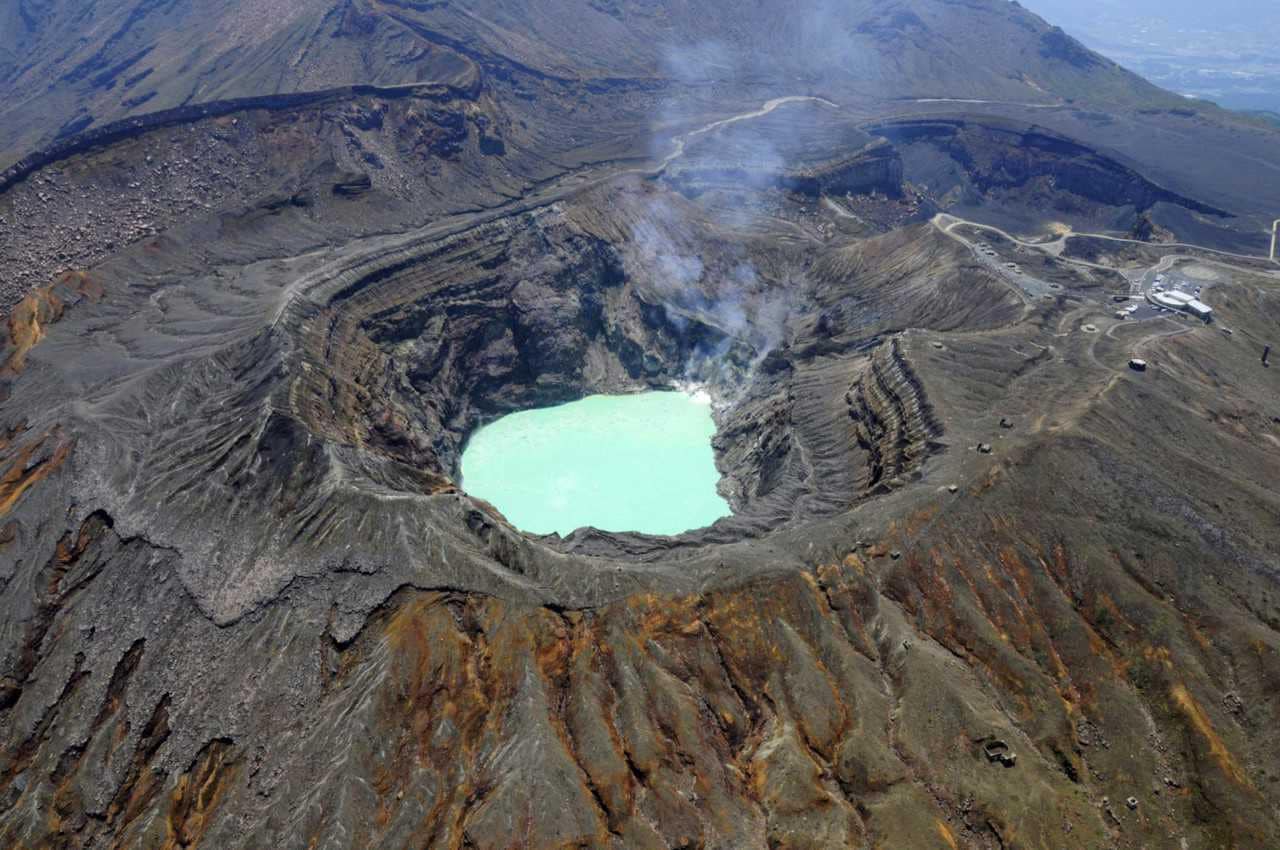
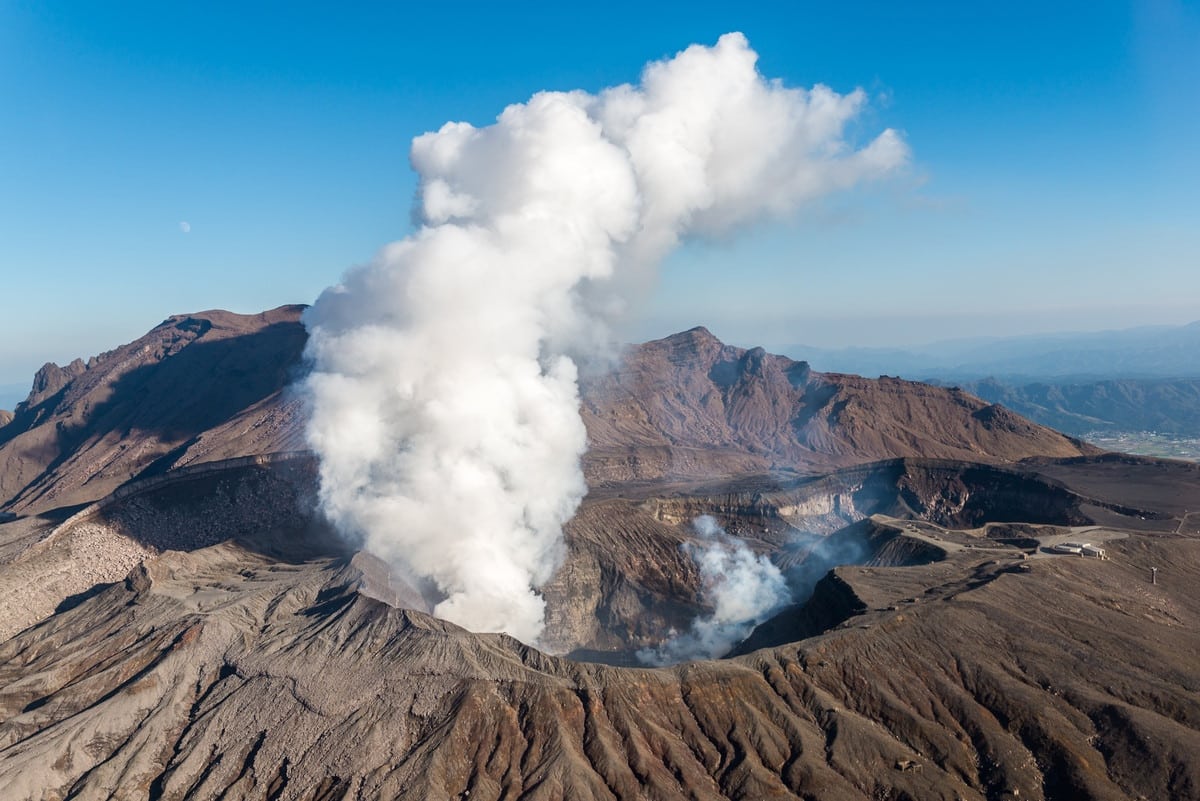
Mount Aso is in Aso City, Kumamoto Prefecture, and is one of the largest calderas in the world. Whether you can get near the crater depends on the day’s restrictions.
Can you visit Mount Aso right now? You can visit Aso, but you can’t get close to the Nakadake crater yet.
Is Mount Aso open? The Aso area is open as usual, and Kusasenri, Daikanbo and Aso Shrine are all accessible. Only the Nakadake crater is off limits and crater viewing has not reopened. There is no fixed reopening date because it depends on volcanic activity.
Conditions change, so before you go check the “Aso Volcano Crater Restriction Information” (Aso Volcano Disaster Prevention Council) and the Japan Meteorological Agency’s Aso volcano information.
- On October 4, 2026, the Aso Volcano Disaster Prevention Council (aso-volcano.jp) showed Eruption Alert Level 2, with entry banned within about 1 km of the crater (Stage 1 restriction).
- Kusasenri, the Aso Volcano Museum, Daikanbo and Aso Shrine are all outside the restricted area and can be visited as usual.
- Crater viewing at Nakadake is still closed and the crater shuttle bus is suspended. As for the Aso-san Park Road, the Aso City website lists it as closed, while the Disaster Prevention Council says it is passable as far as the mountaintop plaza. Please rely on live official announcements.
One of the World’s Largest Calderas: A Giant Volcanic Basin 25 km From North to South
Aso is not a single mountain but a whole landscape of enormous caldera. A massive eruption about 90,000 years ago emptied the magma chamber underground and the surface collapsed, creating a depression about 25 km from north to south and about 18 km from east to west, one of the largest calderas in the world.
Even more unusual, about 50,000 people still live inside this basin, which has towns, farmland, schools and railways, making it a rare “inhabited caldera.” The peaks that rise in the middle of the basin, Takadake, Nakadake, Nekodake, Kishimadake and Eboshidake, are together known as the Five Peaks of Aso. Seen from the outer rim on the north side, the ridgeline looks like a Buddha lying on his back, which is why it is called the “Nehan-zo” (reclining Buddha). Once you understand this terrain, it makes sense why every viewpoint in Aso shows you a different landscape.
Must-Know Before You Go: Aso Crater Restrictions Can Change at Any Time
What you most need to check in advance for Aso is not the weather but the volcanic activity level.
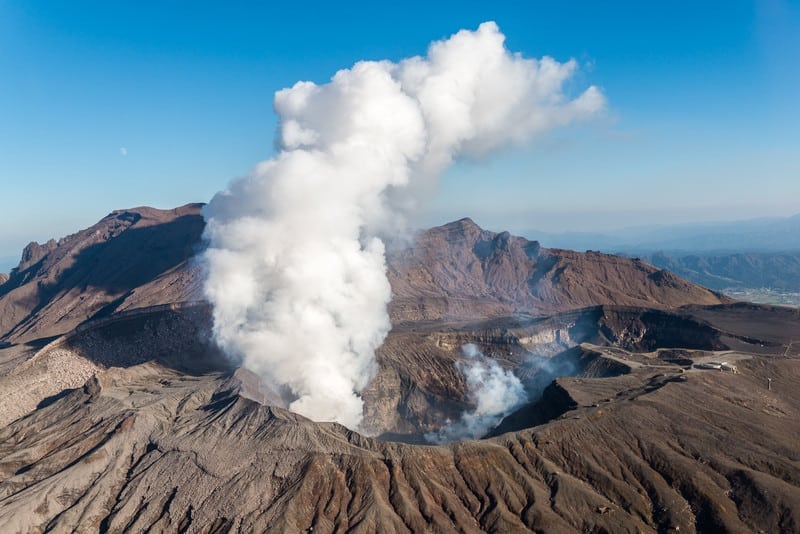
The Japan Meteorological Agency (JMA) issues Eruption Alert Levels based on volcanic activity. When the level goes up, a restricted zone is drawn around the Nakadake crater.
Inside the restricted zone, crater viewing, some hiking trails and the Aso-san Park Road close, and the shuttle bus stops running.
A recent example: on August 14, 2026, the Fukuoka District Meteorological Observatory raised Aso’s Eruption Alert Level from 2 to 3 (entry restriction), banning all entry within a radius of about 2 km from Nakadake’s No. 1 crater. On September 1 it was lowered back to Level 2, and from September 2 the restriction returned to a Stage 1 restriction covering about 1 km around the crater. Information issued by the Fukuoka District Meteorological Observatory at 4 p.m. on October 2 still showed Level 2. Changes like this can go up or down within a few days, so no guide should ever promise that you will “definitely see the crater.”
How far you can actually walk is determined by the restriction information published by the Aso Volcano Disaster Prevention Council on the day you depart.
Who Should Come? Recommended Length of Stay, Seasons and Itinerary Focus
Aso suits travelers who love grand natural scenery and want to fit a day of open landscapes into a Kyushu itinerary. If you drive, you can comfortably cover Kusasenri, Komezuka, Daikanbo and Aso Shrine in one day. If you rely on public transport, the buses up the mountain run only about 9 times a day, so focus on the Kusasenri area and around Aso Station and keep the schedule relaxed.
As for seasons, new grass comes up after the spring grass burning, Kusasenri is at its greenest in summer, the pampas grass turns golden in autumn, and in winter snow may close the roads. The altitude is high and it is windy, so even in summer we recommend bringing a light jacket. If the crater is closed there is no need to cancel your trip at all. Kusasenri, Daikanbo, Aso Shrine and the Shirakawa spring are all outside the restricted area, and the alternative routes covered in the second half of this article are just as impressive.
How to Get to Mount Aso: JR Limited Express, Sankō Bus and Driving Routes
From Kumamoto, the JR limited express plus Sankō Bus gets you to Kusasenri in about 2 hours.
| Leg | Method and cost | Current status |
|---|---|---|
| Kumamoto Station → JR Aso Station | JR Hohi Main Line limited express, about 1 hr 15 min to 1.5 hr | Aso Boy!, Kyushu Odan Express |
| Aso Station → Kusasenri | Sankō Bus Aso Crater Line, about 30 min | Currently runs only as far as Kusasenri |
| Kusasenri → Aso-san Jo Terminal | Extension of the Aso Crater Line | Under restrictions, service suspended |
| Aso-san Jo Terminal → Nakadake crater | Crater shuttle bus, ¥800 one way for adults | Under restrictions, service fully suspended |
From Kumamoto or Hakata: JR Limited Express and the Kyushu Odan Bus
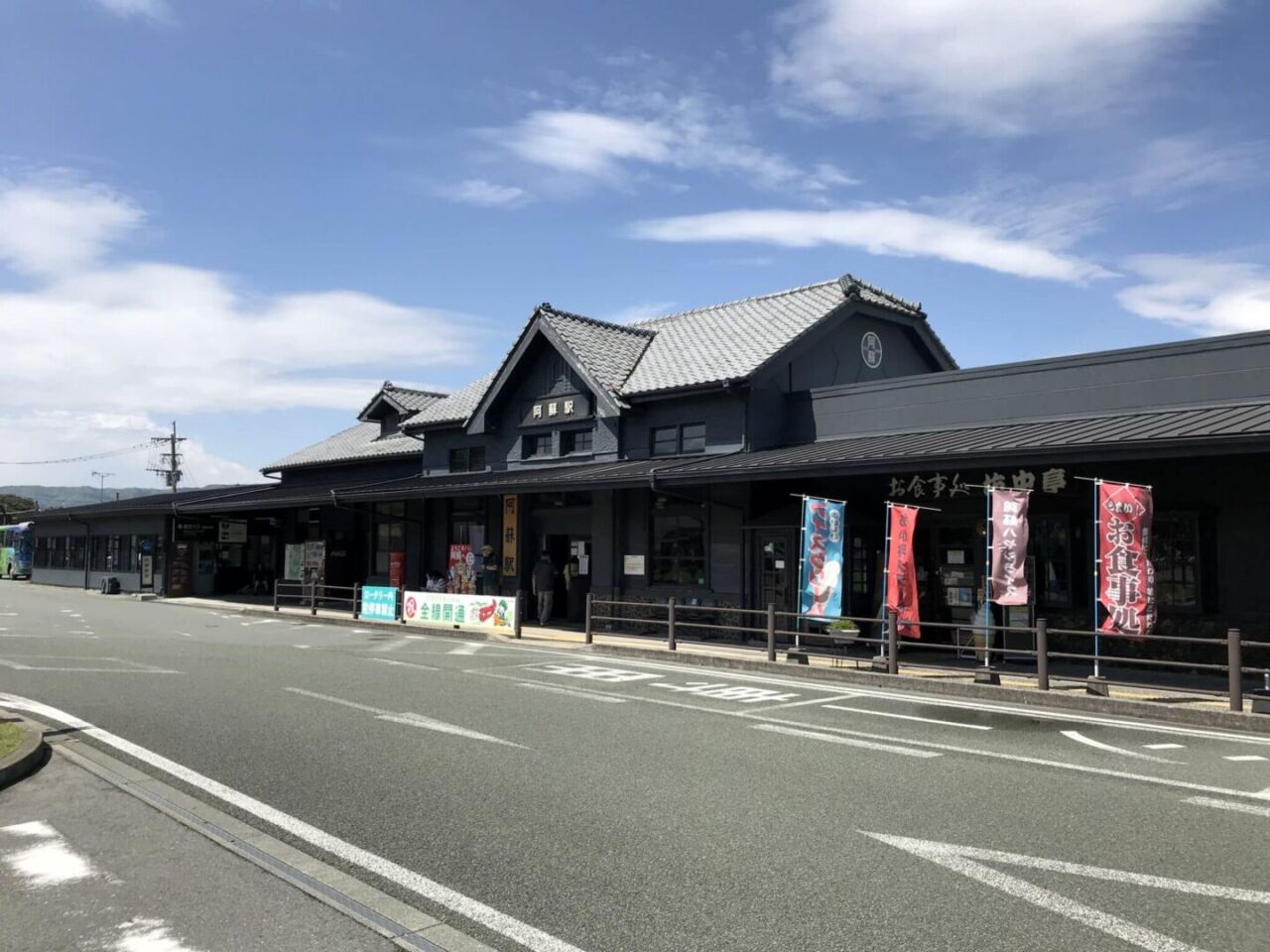
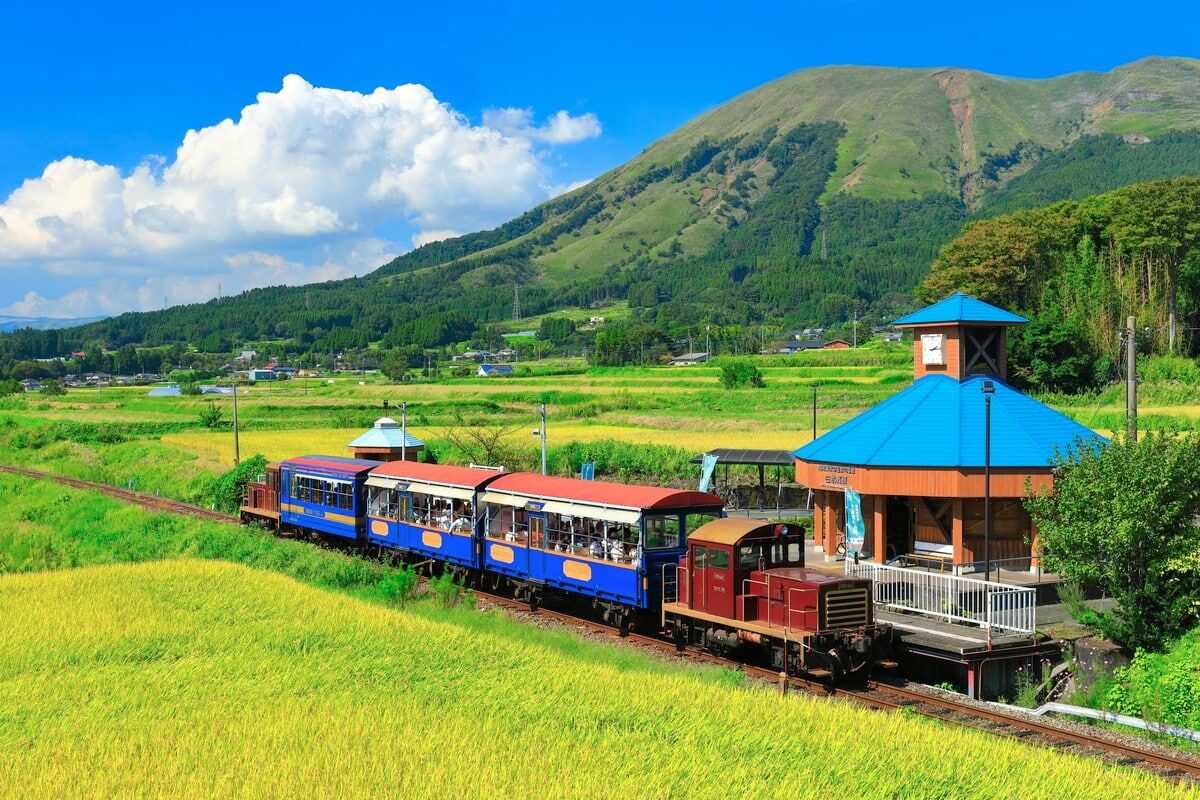
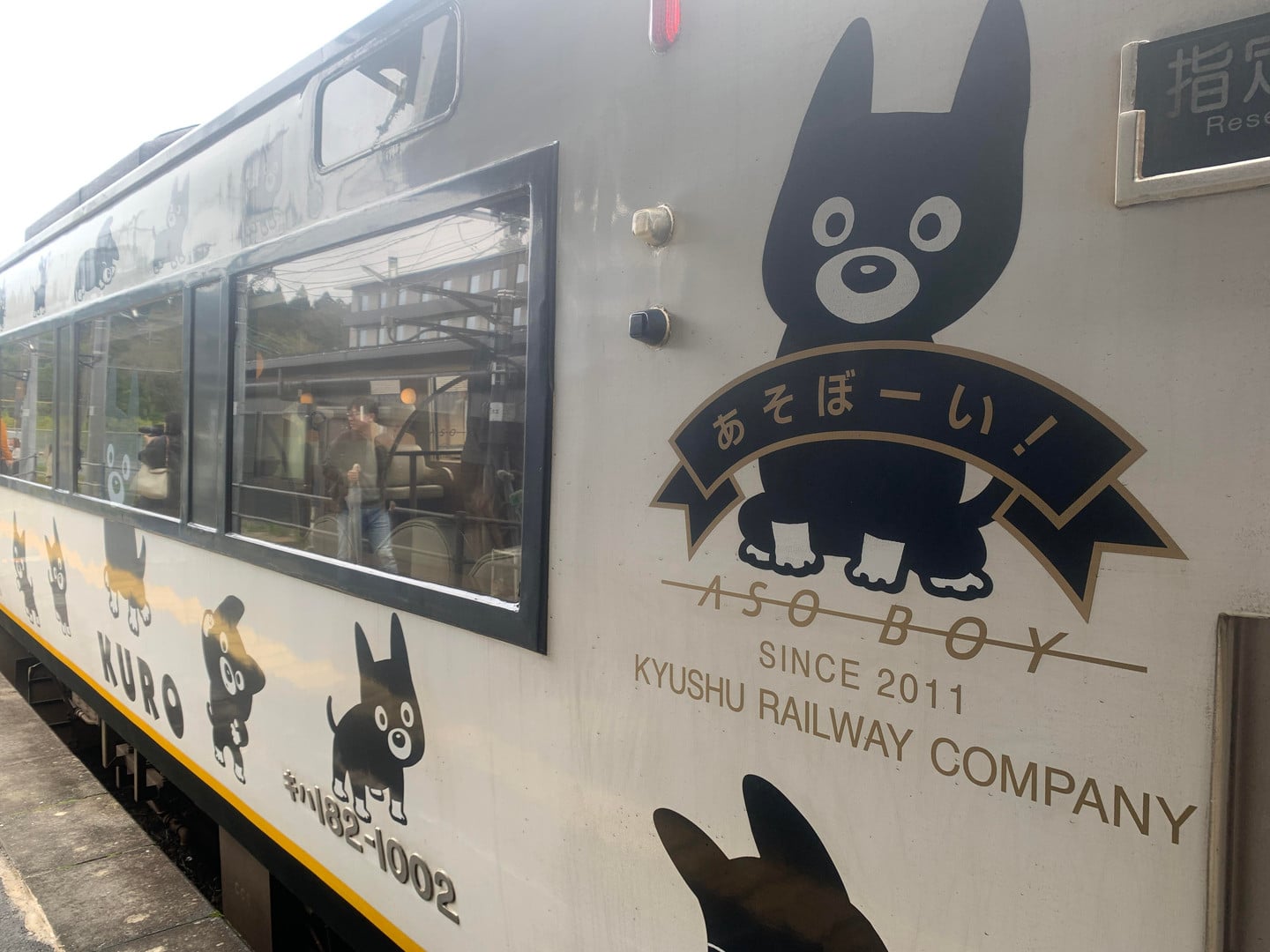
The most common route is to take the Hohi Main Line limited express from JR Kumamoto Station straight to JR Aso Station, a ride of about 1 hour 15 minutes to 1.5 hours. The limited express services include the sightseeing train “Aso Boy! (あそぼーい!)” and the “Kyushu Odan Express.” The former has family seating and a lookout car and is an attraction in itself, so in peak season we recommend reserving a seat in advance.
If you’d rather not take the train, you can also board the “Kyushu Odan Bus” or the “Yamabiko-go” (Yamabiko) from the Kumamoto Sakuramachi Bus Terminal, which goes direct to the Aso Station area. From Hakata you first need to take the Shinkansen to Kumamoto and then transfer to the Hohi Main Line, about 2.5 to 3 hours one way. A day trip would be very tight, so we recommend staying a night in Aso or Kumamoto.
One more reminder: trains on the Hohi Main Line are not frequent, and the travel time differs quite a bit between the limited express and local trains. If you plan a day trip, check the outbound and return timetables first, so you don’t arrive at Aso Station only to find there is no connecting bus up the mountain.

The Main Way Up: Sankō Bus Aso Crater Line (Currently Only to Kusasenri)
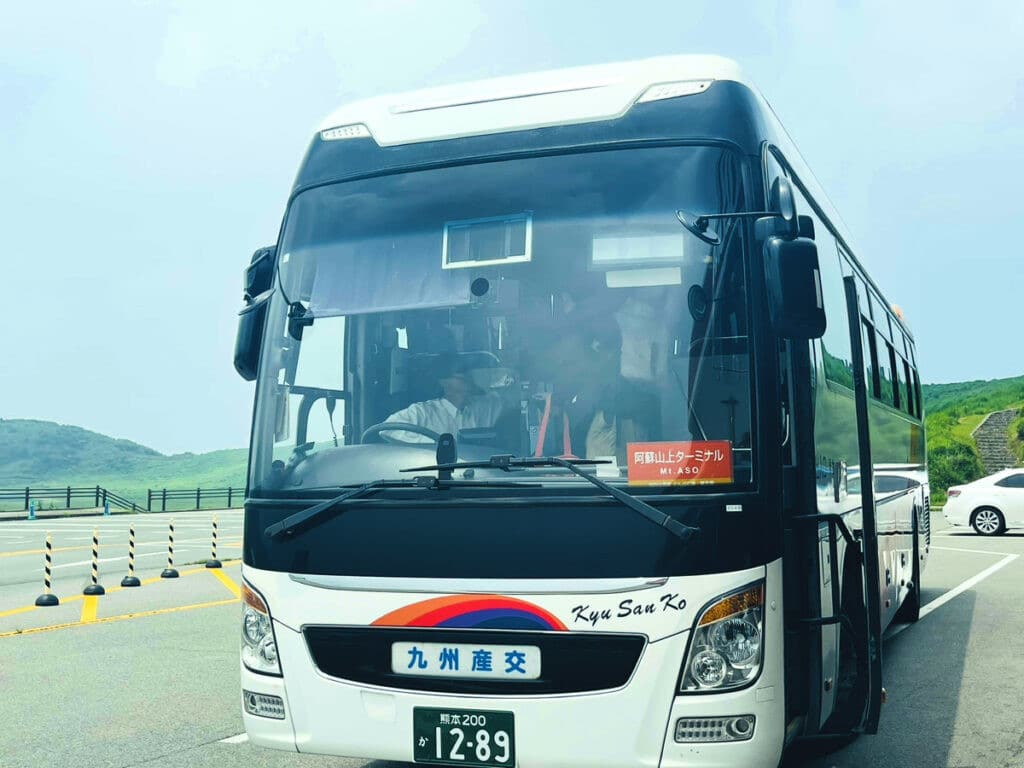
The way up from JR Aso Station is the Sankō Bus Aso Crater Line (Aso Tozan Line). It stops at “Kusasenri / Aso Volcano Museum,” and its terminus was originally the Aso-san Jo Terminal, with the full ride taking about 35 minutes one way. There are 9 departures from Aso Station and 10 from the Jo Terminal, the same on weekdays and holidays.
Because of the current crater restrictions, this route runs only between Aso Station and Kusasenri and does not stop at the Aso-san Jo Terminal or the helipad. Buses are infrequent to begin with, so we strongly recommend photographing the day’s timetable at the Sankō Bus stop as soon as you reach Aso Station and locking in your return bus before heading up. Otherwise it is easy to get stranded at Kusasenri.
On the bus, you board at the rear door and take a numbered ticket, then pay at the front door when you get off. Cash is accepted on board. If you have an Aso Tozan Line one-day pass, just show it when you get off, with no need to buy a ticket for each ride.
The Crater Shuttle Bus and the Demolished Aso Ropeway
Many older articles still say “take the ropeway up to the crater,” but that is no longer possible. The Aso ropeway was damaged in the 2016 Kumamoto earthquake and by volcanic activity, the rebuilding plan was later cancelled, and the facility has been demolished. There is no ropeway on the mountain today.
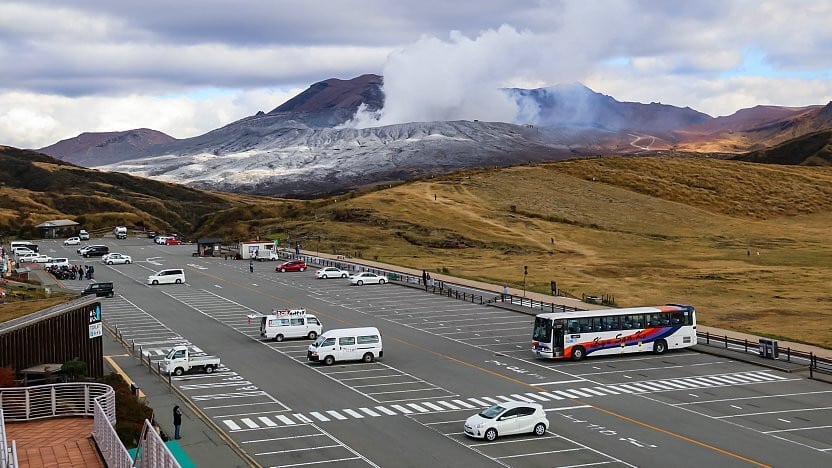
Taking its place is the “Aso-san Crater Shuttle Bus,” which began service in November 2020 and is operated by Sankō Bus. The ride from the Aso-san Jo Terminal to the Nakadake crater takes about 5 minutes. In normal operation it costs ¥800 one way for adults and ¥400 for children, and the terminal is open from 9:00 to 16:30. However, the Aso-san Park Road is currently closed, and the Sankō Bus website (updated September 2) shows the crater shuttle bus as suspended.
The Aso-san Jo Terminal has a tourist information office, a gift shop and a parking lot, and is the hub for the trip up the mountain.
A September 2 notice from the Minami-Aso Tourism Bureau lists the mountaintop terminal as a facility that can still be visited at Level 2, but whether buses run up to the mountain and whether each facility is open that day should be confirmed through live official information. We recommend setting Kusasenri as the end point of your trip for now.
For Drivers: The Aso Panorama Line and Parking Information
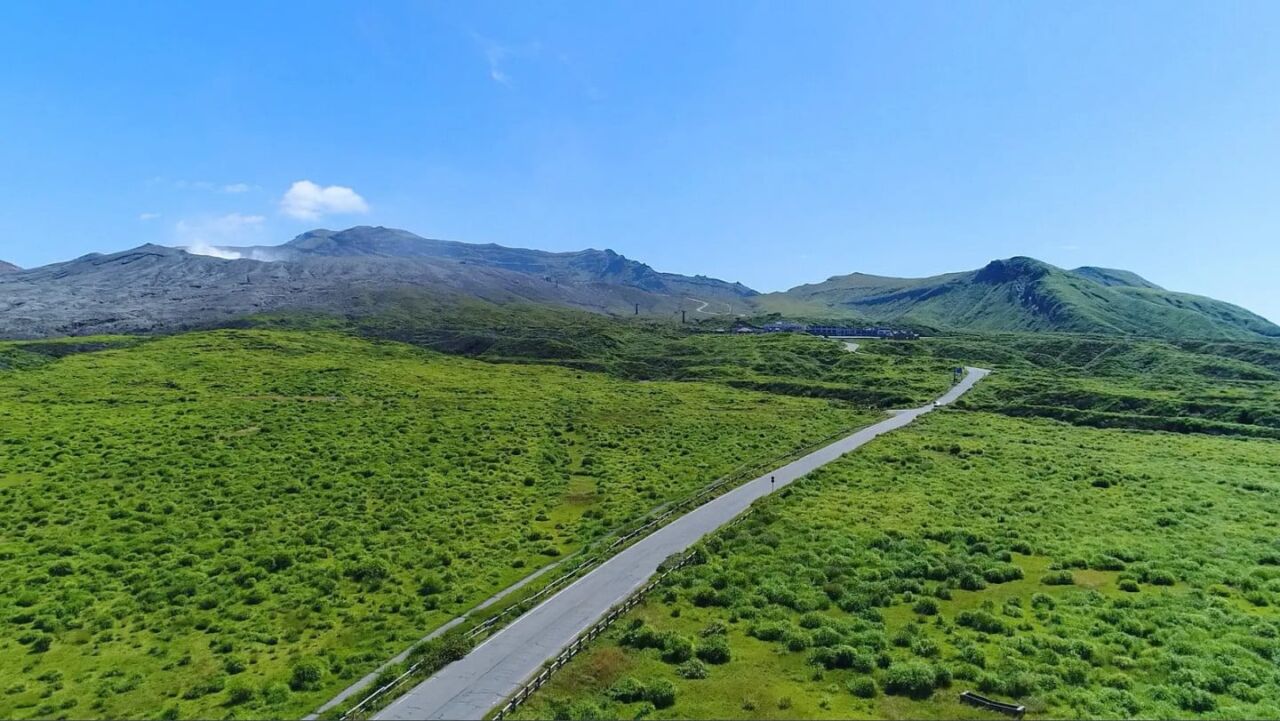
Driving is the most efficient way to see Aso. From central Kumamoto, take Route 57 or a prefectural road up to the outer rim, then join the “Aso Panorama Line (阿蘇パノラマライン).” This links Komezuka, Kusasenri and the Aso Volcano Museum in one run, with several free-parking lookout points along the way, making it a prime route for photography.
Note that the “Aso-san Park Road” leading to the Nakadake crater is a toll road and is closed outright during crater restrictions. Navigation will still show the route, but you can’t get through on site. The Kusasenri parking lot is a paid lot costing about ¥500, while the Daikanbo parking lot is free and it is about a 5-minute walk from the lot to the lookout. Fog and strong winds are common in the mountains, and in winter you may need snow tires or chains.
Also note that gas stations around Aso are sparse and some close in the early evening, so fill up in town before heading up. Mobile signal in the mountains can also be unstable, so it is best to download your navigation route offline in advance.


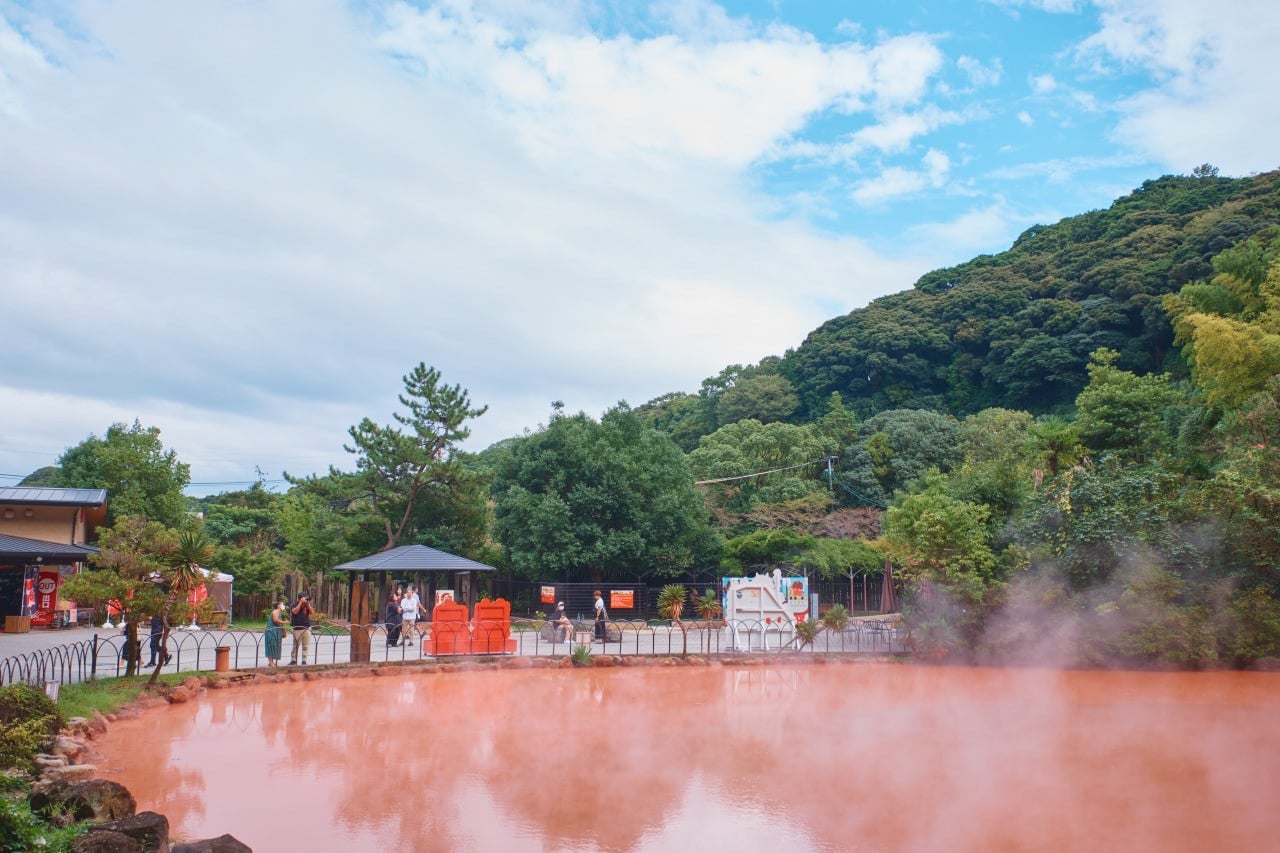
Mount Aso Must-See Spots: Kusasenri, Daikanbo and Around the Crater
Below, in order from around the crater to the outer rim and Minami-Aso, are the 14 stops in Aso most worth lingering at.
Nakadake Crater: Whether You Can Approach Depends Entirely on the Day’s Restrictions
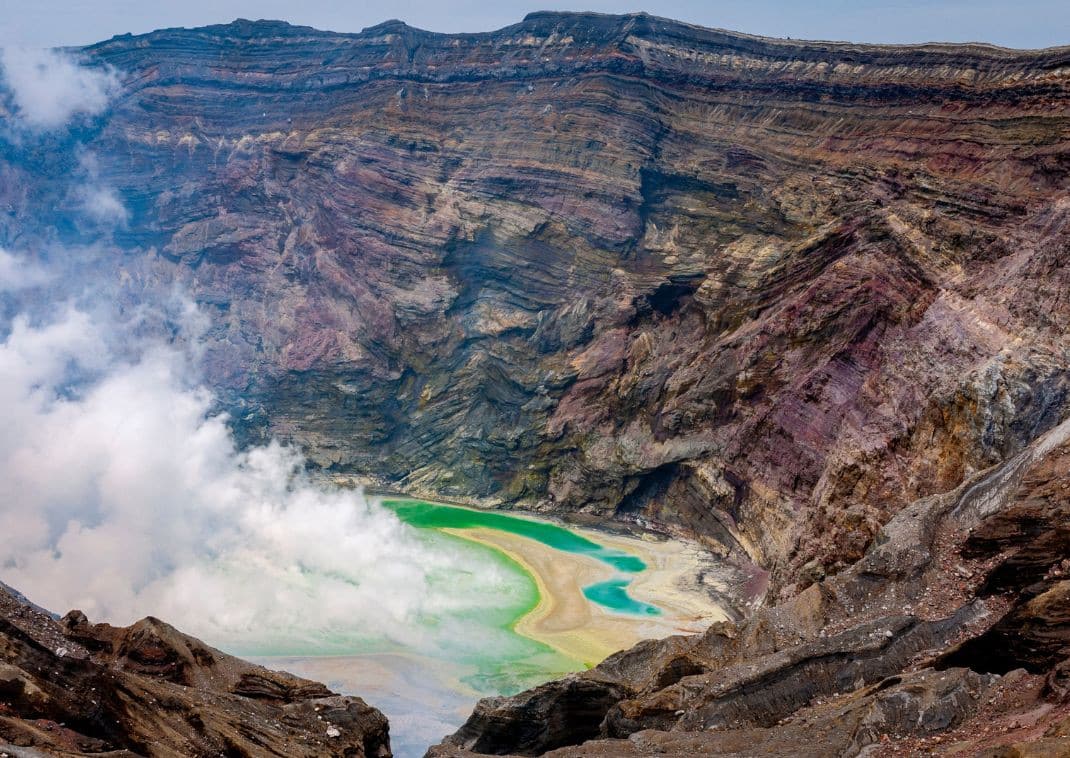
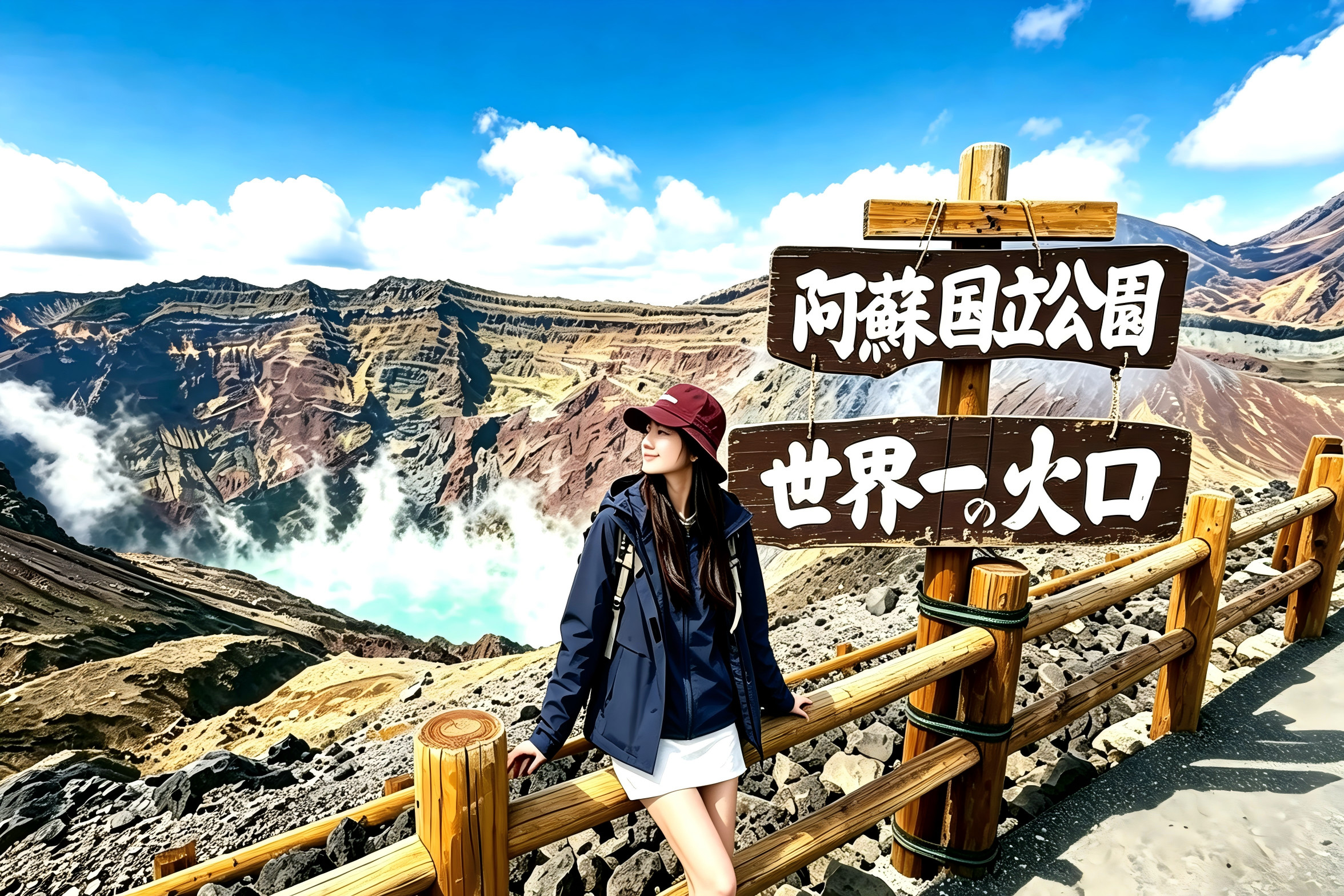
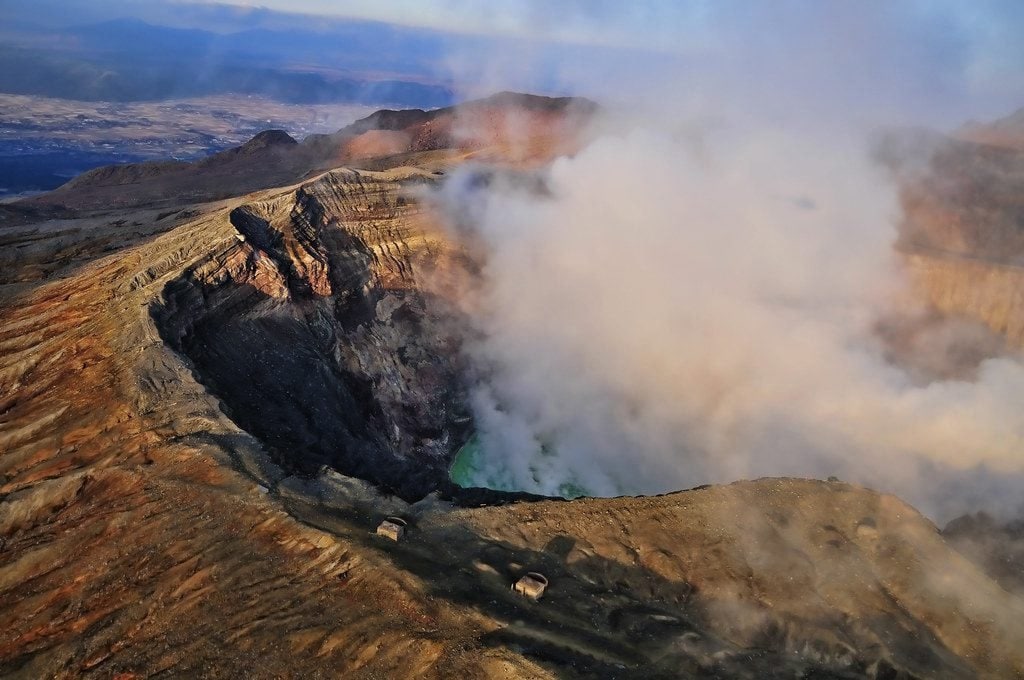
The Nakadake No. 1 crater is the still-active heart of Aso, about 600 meters across and about 130 meters deep. When open, you can stand at the lookout on the crater rim and look down at the emerald-green crater lake and the white plumes of steam that keep rising. It is one of the few places in all of Japan where you can walk to the edge of an active volcano’s crater.
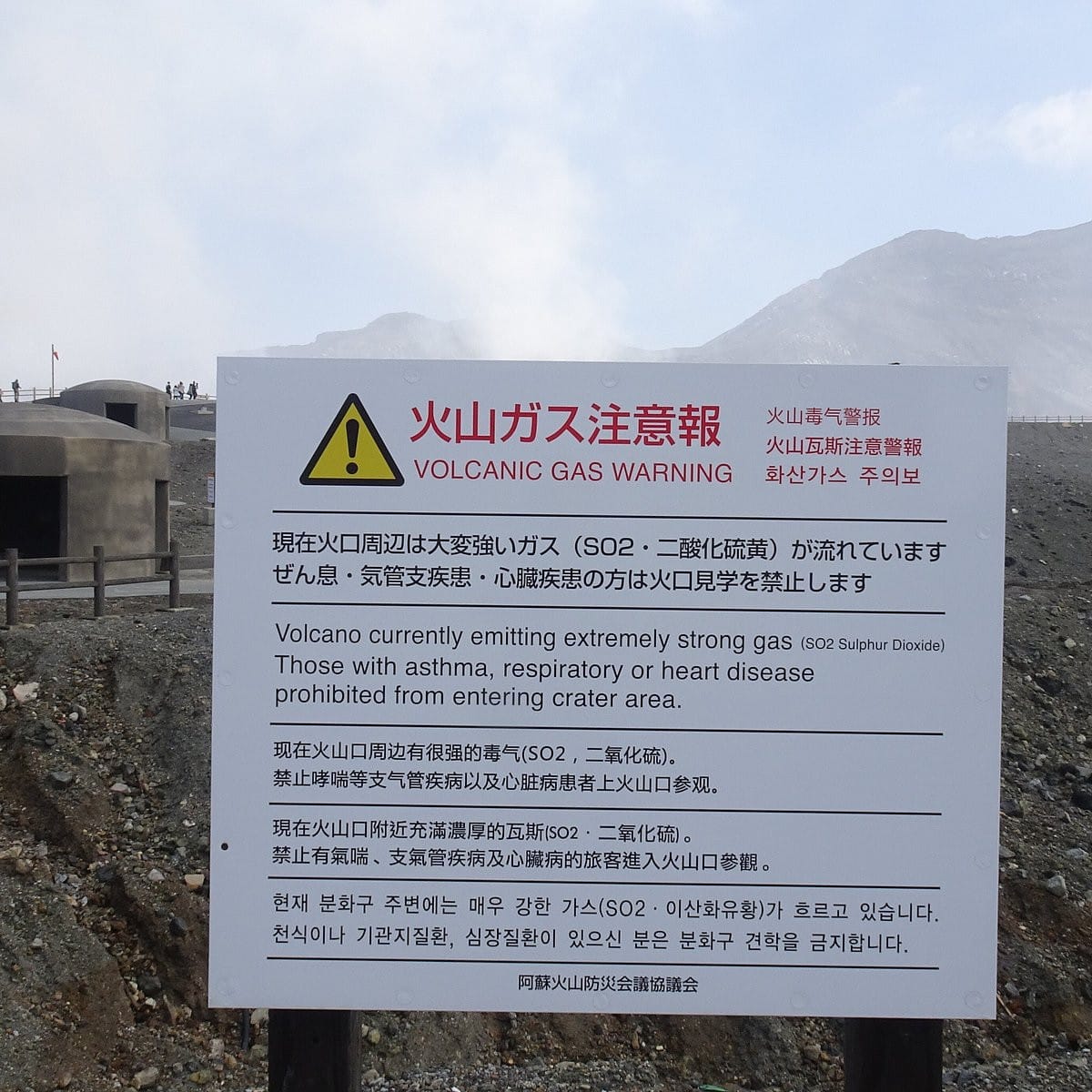
But this always comes with conditions. Mount Aso had been held at Eruption Alert Level 3 (entry banned within 2 km of the crater) since August 14, 2026, but it was lowered back to Level 2 at 4 p.m. on September 1, 2026, and from 9 a.m. on September 2 it changed to a Stage 1 restriction, shrinking the no-entry area to about 1 km around the crater. Crater viewing has still not reopened. (The Disaster Prevention Council says the road is passable as far as the mountaintop plaza, but the Aso City website still lists the Aso-san Park Road as closed, so please check both before you go and rely on live official announcements.) Even when the level drops to 2 or 1, evacuation shelters and “Volcanic Gas Warning” signs remain on site, and people with asthma, bronchial conditions or heart conditions are advised against entering. Be sure to confirm the restrictions on the day of departure before making plans.

- ⚠️ Current restrictions: A crater-vicinity warning (Eruption Alert Level 2) is in effect, with entry banned within about 1 km of the crater (Stage 1 restriction)
- 🕘 Aso-san Park Road hours: Summer (Mar 20 to Oct 31) 8:30 to 18:00 (gate closes 17:30) / Autumn (Nov 1 to Nov 30) 8:30 to 17:30 (gate closes 17:00) / Winter (Dec 1 to Mar 19) 9:00 to 17:00 (gate closes 16:30); entry is completely prohibited at night
- 🔗 Aso Volcano Crater Restriction Information (Aso Volcano Disaster Prevention Council)
Kusasenri-ga-hama: A 1 km-Wide Crater-Floor Grassland
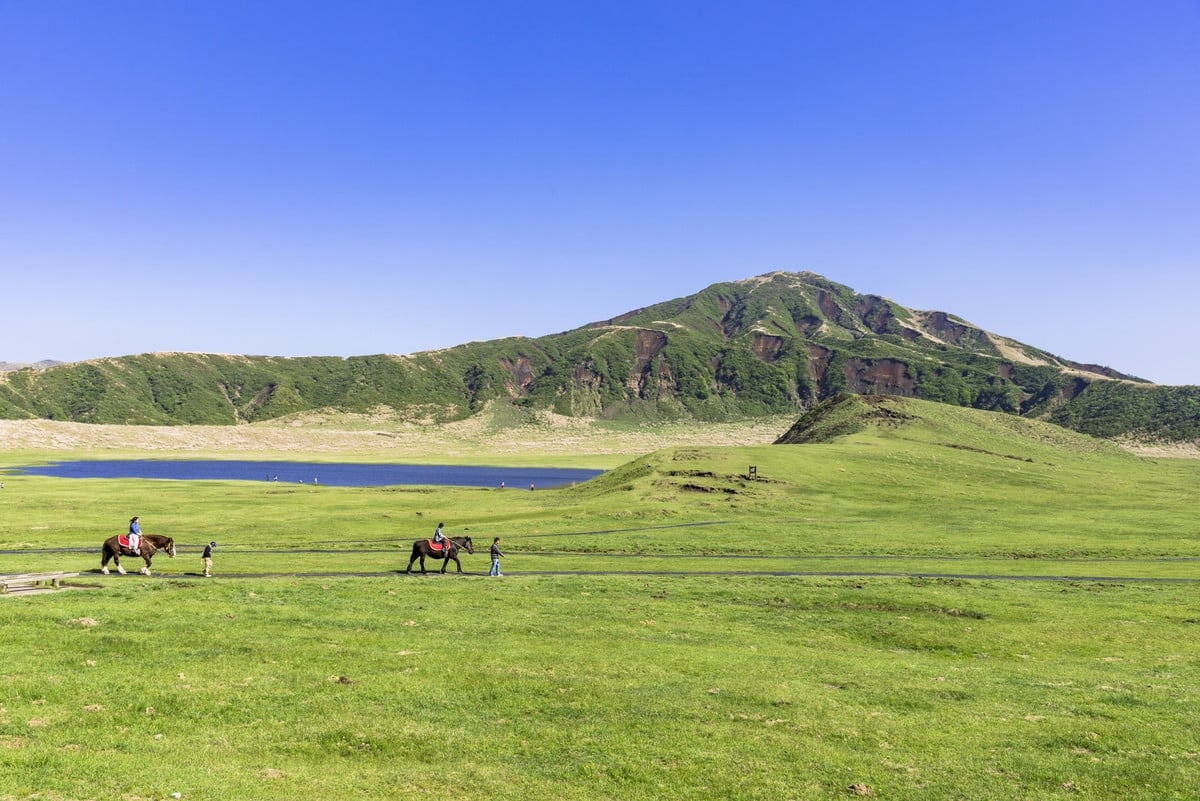
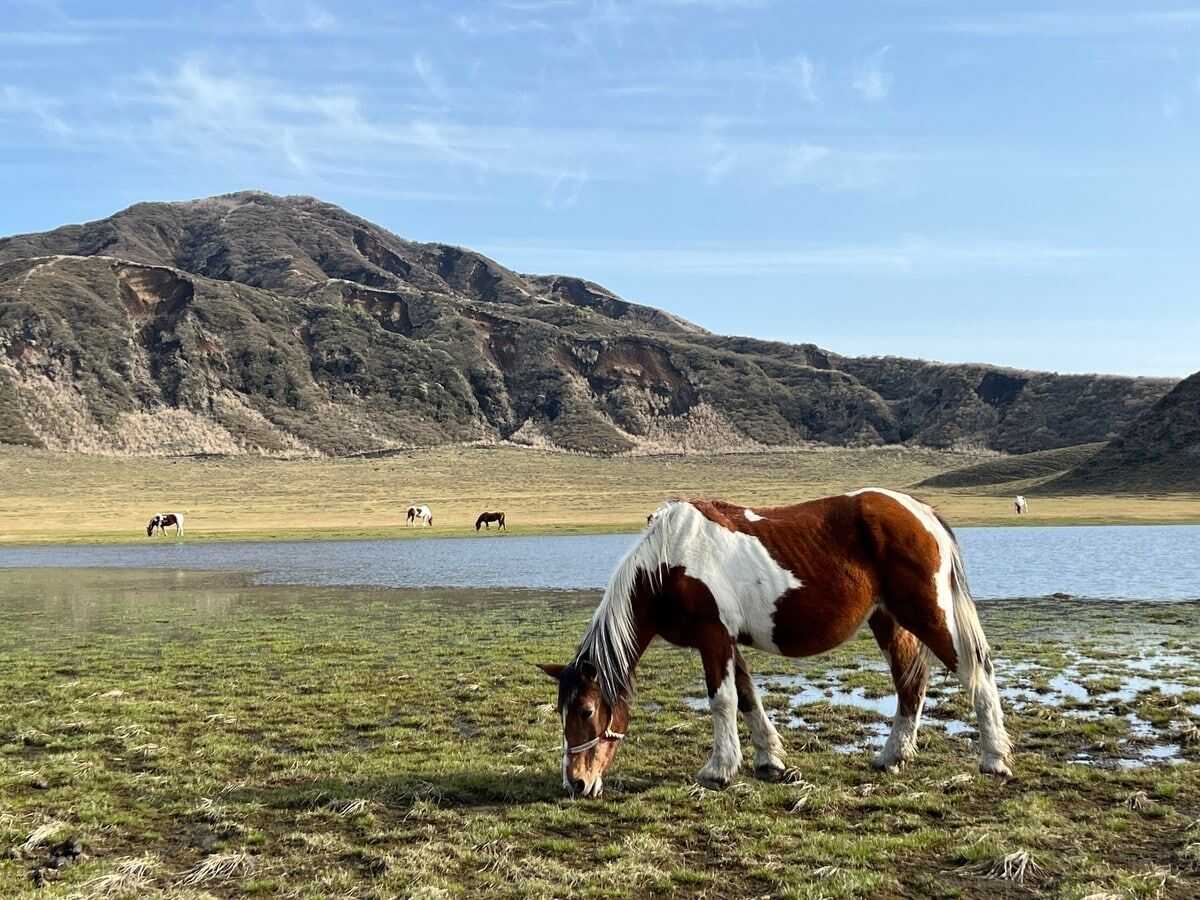
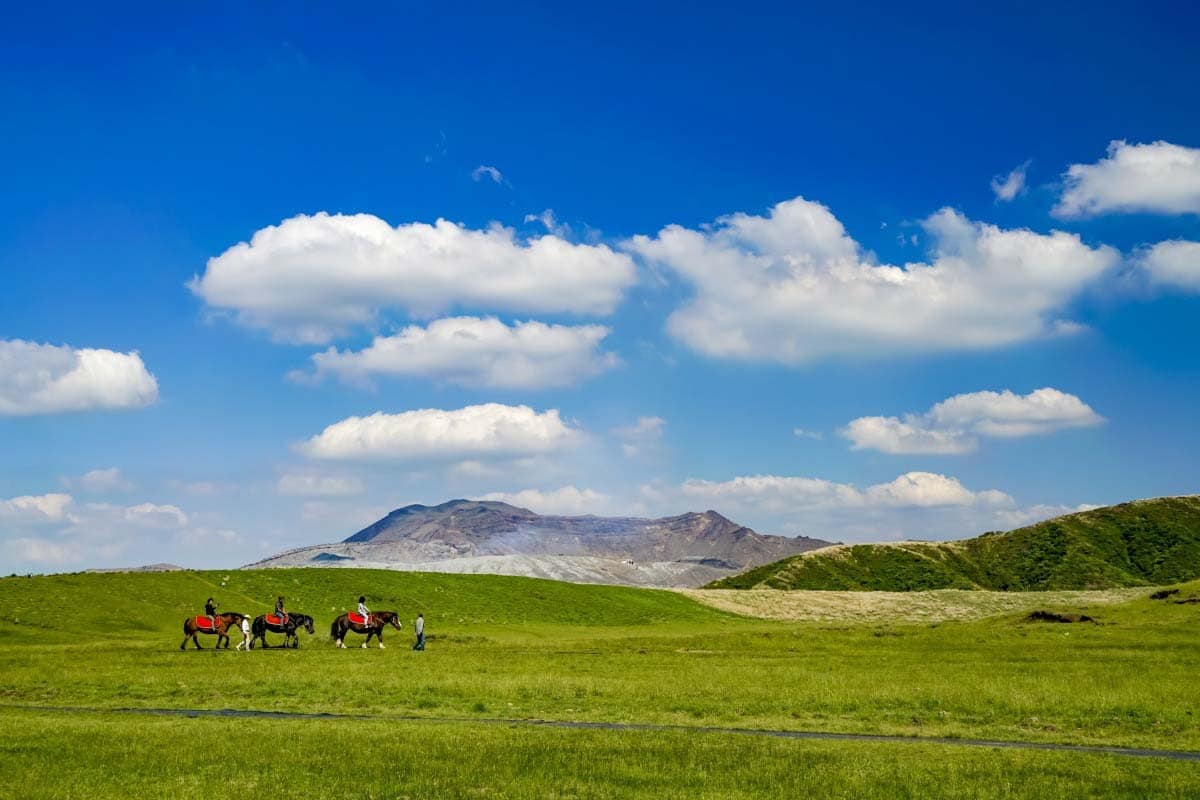
Kusasenri-ga-hama is Aso’s most photogenic scenery and the most important alternative destination when the crater is closed. It is actually a crater floor about 1 km in diameter on the northern slope of Eboshidake, with two ponds in the middle, wide grassy slopes all around, horses grazing on the grass, and the constantly steaming Nakadake as the backdrop.
This area is entirely outside the crater restriction zone and you can stroll freely at any time. A loop takes about 40 to 60 minutes. The slanting light in early morning and evening is best for photos, and after rain the ponds reflect the sky and the mountains in a classic view. At an elevation of about 1,100 meters, the wind is strong and it feels cool, so a light jacket is recommended even in summer.
The grassland has no shelter, so sun protection and warm clothing are both needed, with strong sun in summer and a biting wind in winter. The ground gets muddy after rain, so wear waterproof shoes that are easy to walk in.
Aso Volcano Museum: See the Crater You Can’t Enter Through Live Cameras
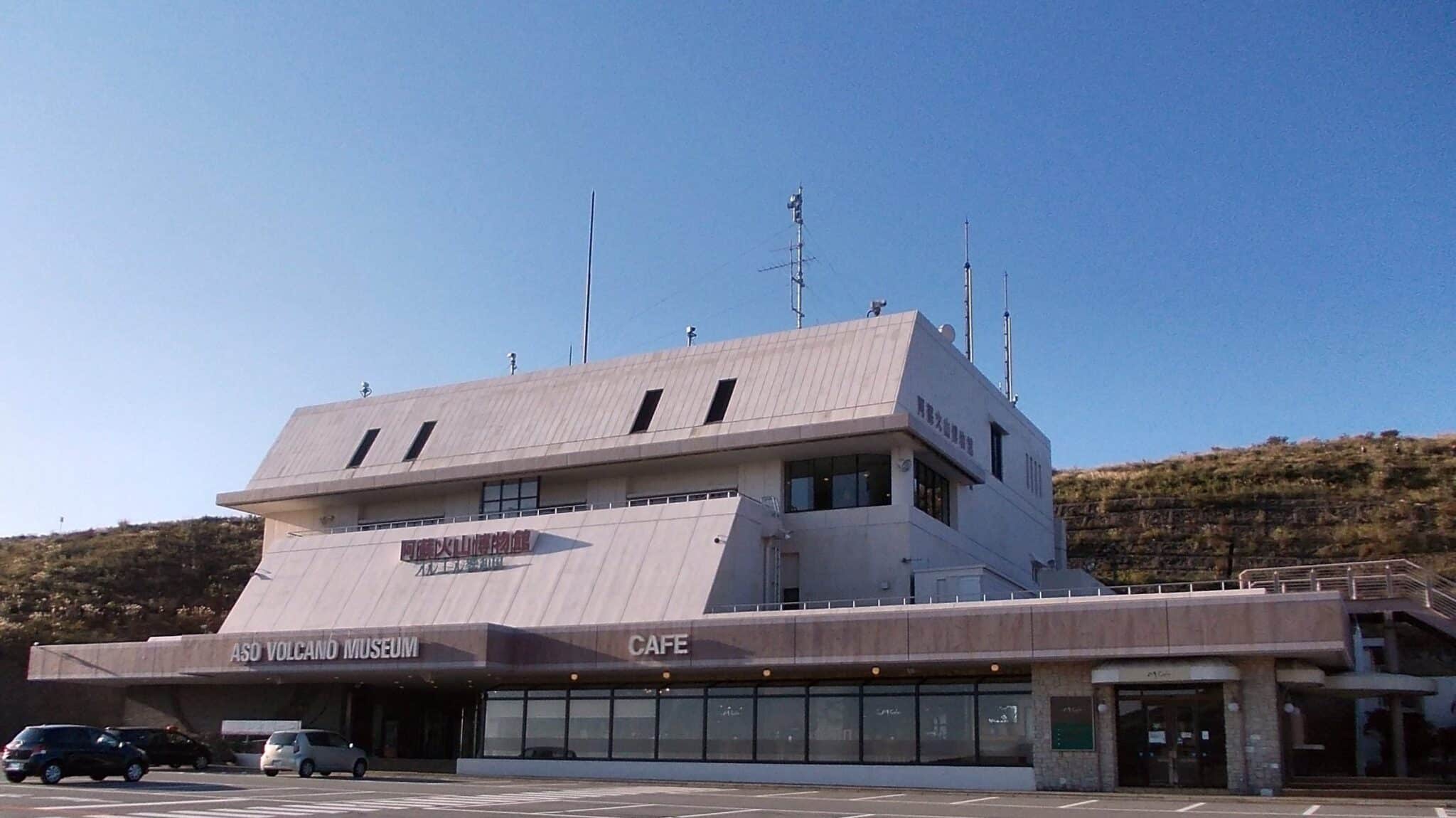
The Aso Volcano Museum is directly across from the Kusasenri parking lot and is the most valuable stop while the crater is closed. Its biggest draw is the live crater camera (火口カメラ) feed from near the crater. When you can’t walk to the crater rim yourself, it is the only way to see the real-time steam inside the crater.
Beyond that, the museum has a giant three-dimensional model of Aso’s terrain and a theater with five large screens that uses video to explain how this world-class caldera formed. Admission is ¥1,300 for adults (junior high school age and up), ¥650 for elementary school students, ¥1,100 for ages 65 and over, and ¥350 for preschool children aged 4 and up. It is open 9:00 to 17:00 (last entry 16:30), and groups of 11 or more get a discount. The address is 1930-1 Akamizu, Aso City.
The museum also has a gift shop and restrooms, making it one of the few indoor rest spots on the mountain. We suggest spending 40 minutes to an hour here, which pairs nicely with a stroll around Kusasenri to make a complete morning.
Kusasenri Rest House: Have a Bowl of Aso Akaushi Beef Don Before Moving On
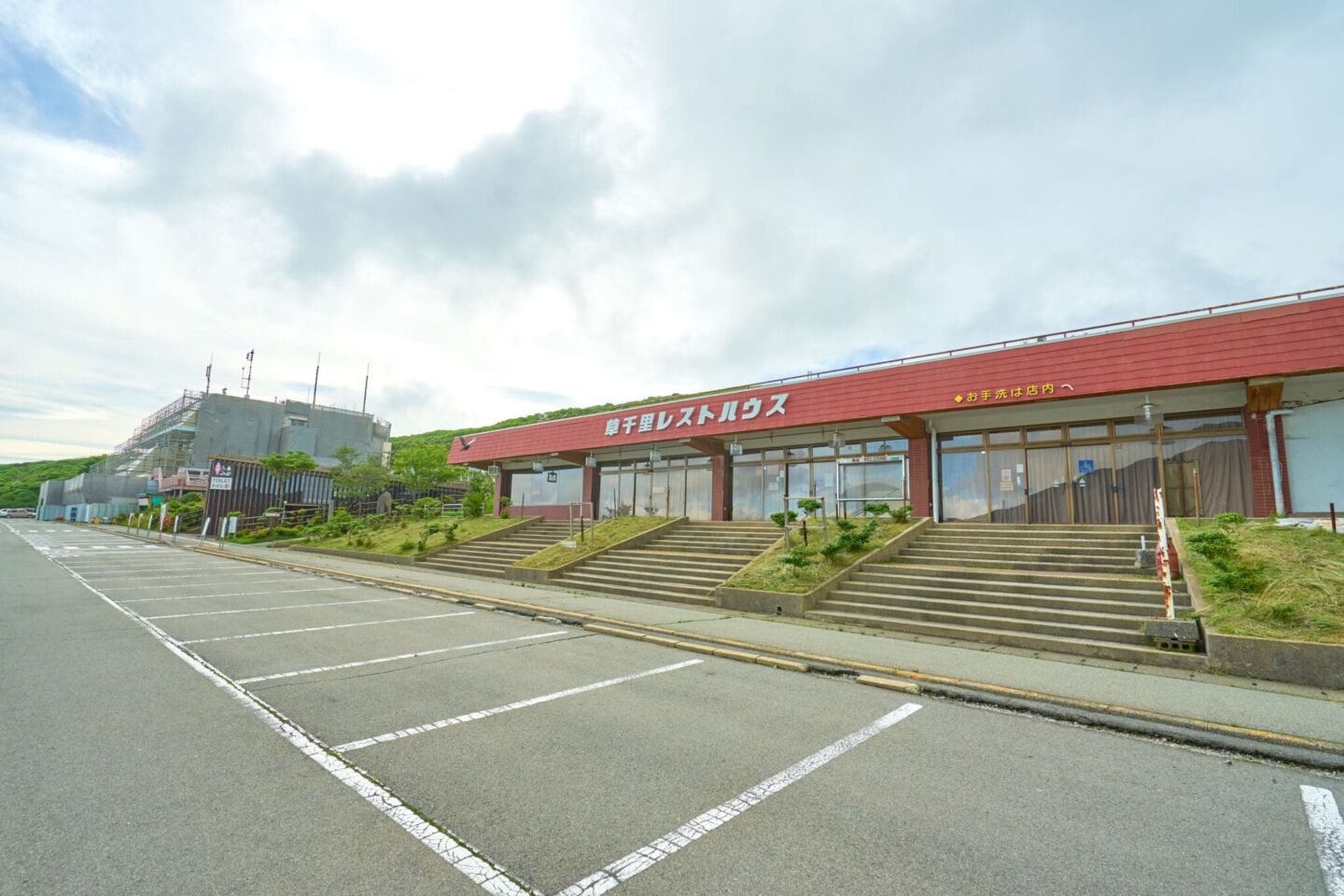
The rest house next to Kusasenri is the only place for meals and supplies in this area, and it stays open as usual during crater restrictions. The signature dish is Aso’s specialty “akaushi don,” a bowl of rice topped with Japanese Brown cattle (Aso akaushi) grazed on the Aso plateau. The meat is lean without being greasy, and it is a must-try when you come to Aso.
The shop also offers soft-serve ice cream and dairy products made with Aso raw milk, and ASOMILK-related drinks and desserts are a popular reason to queue, tasting especially good with the grassland view through the window. There is also a souvenir corner and restrooms, making this an important waypoint on the trip up the mountain. Food options on the mountain are very limited, so we recommend scheduling lunch right here rather than counting on finding food near the crater.
Peak dining hours cluster around noon, and when tour groups arrive you have to queue, so go earlier or half an hour later to avoid them. Shops on the mountain mostly close early to match the last bus, so if you head up later in the afternoon, check whether they are open first.
Sunasenri-ga-hama: The Black Volcanic Wasteland That Closes With the Crater
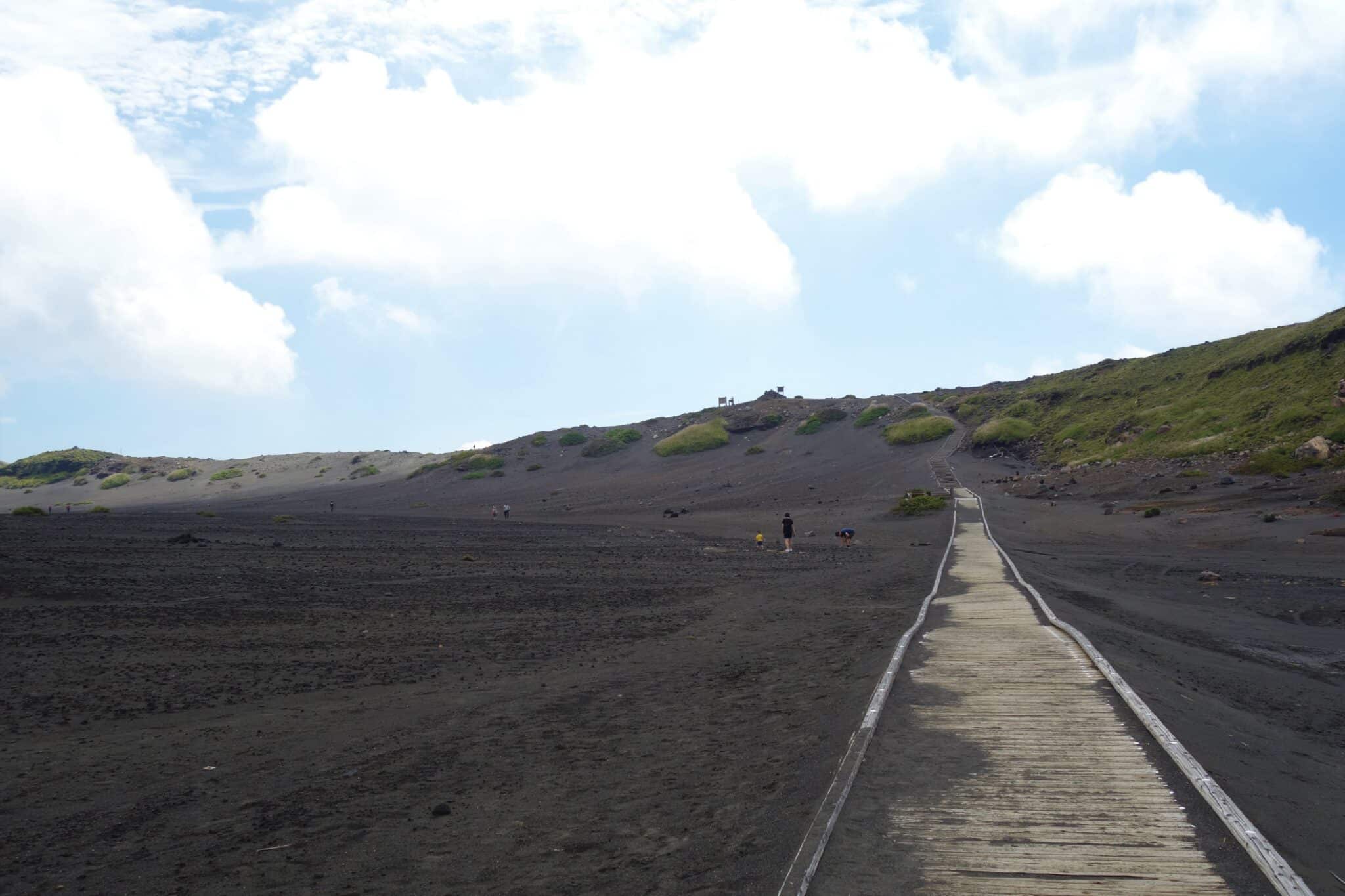
Sunasenri-ga-hama lies south of the Nakadake crater and is a vast expanse of black volcanic sand and gravel where nothing grows. A boardwalk lets you go deep into it, and walking on it feels like stepping onto another planet. It is a popular spot for photography and film shoots.
Because it is right beside the crater, its fate is tied to the crater’s.
When the level is 3 and a 2 km restricted zone is drawn, Sunasenri-ga-hama closes at the same time.
It is currently Level 2 with a 1 km restriction, so whether you can enter depends on the official announcement on the day of departure. Many people assume that the crater is closed but Sunasenri can still be walked, so before you go please check both together.
When open, it is about a 10-plus-minute walk from the Aso-san Jo Terminal. The boardwalk is flat and easy to walk, but there is no shelter at all along the way, and strong wind and falling ash are noticeable. We recommend wearing a hat and a mask, and not stepping off the boardwalk onto the gravel.
Komezuka: The Pudding-Shaped Volcanic Cone You Can’t Climb
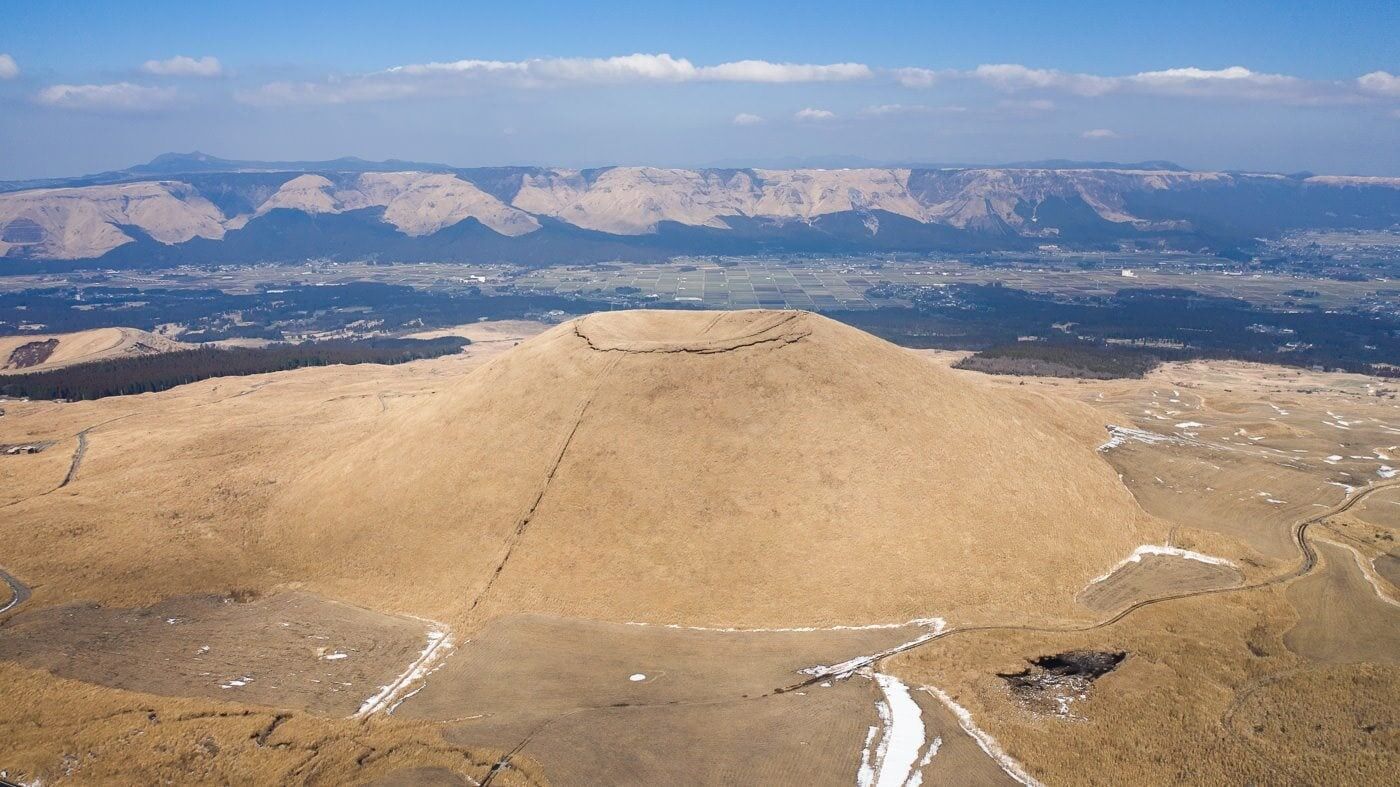
Komezuka is Aso’s cutest landmark, a small volcanic cone about 80 meters high with a dent in the top. From a distance it looks like an upside-down pudding or a full bowl of rice. Legend says the god Takeiwatatsu-no-mikoto piled rice into a mountain to share with the people, and the dent at the top is where he scooped the rice away.
An important reminder: climbing Komezuka is currently prohibited. It used to be open for walking up, but visitors’ trampling degraded the vegetation on the grassy slope and turned up the ground surface, so entry has been banned entirely for nature conservation. Please don’t climb just because you saw old photos. The way to enjoy it is from a distance at the lookout points along the Aso Panorama Line, where the “Komezuka-shita Park” has a parking lot and restrooms and is the most convenient place to shoot. Each season has its own charm: the blackened ground after the spring grass burning, the lush green of summer and the golden hues of autumn.
Aso Panorama Line: The Scenic Drive Linking Kusasenri and Komezuka
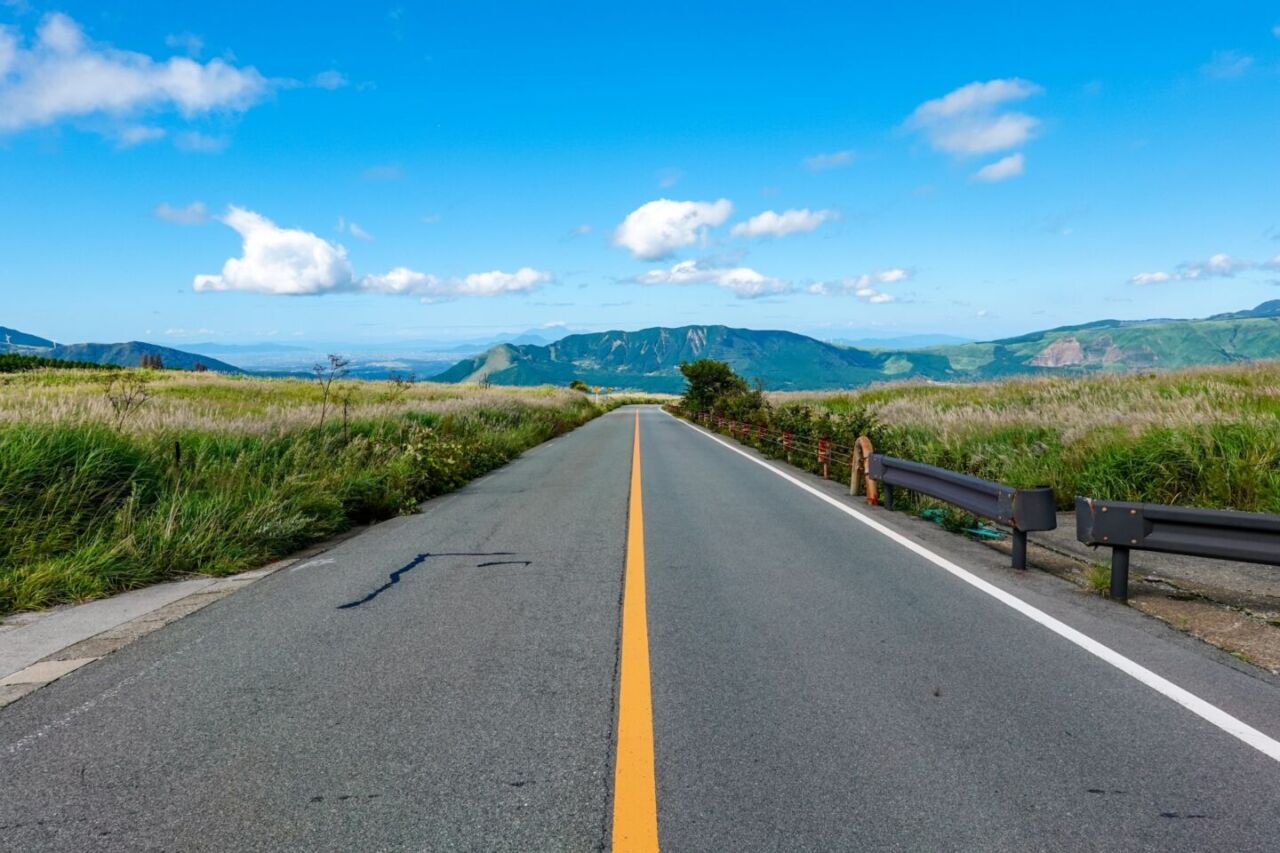
The Aso Panorama Line (阿蘇パノラマライン) is a scenic road climbing from the outer rim up to the central cones, more than ten kilometers in all, with lookout pullouts at different elevations along the way. You can take in Kusasenri, Komezuka and the layers of the Aso Valley in one go, which makes it the most enjoyable stretch for drivers.
As the road gains altitude, the vegetation changes from farmland to grassland to volcanic gravel, so in just half an hour you can feel a clear vertical change. Note that this road differs from the toll road leading to the crater. The Panorama Line itself is normally passable, but the sections near the crater close along with the restrictions. Fog is common in the mountains, so slow down when visibility is poor and watch out for grazing cattle and horses crossing the road.
The lookout pullouts along the route are mostly free, but spaces are few and fill up easily on holidays. Please stop to take photos only in the marked pullouts rather than parking on the shoulder, since this road has many curves and blind spots.
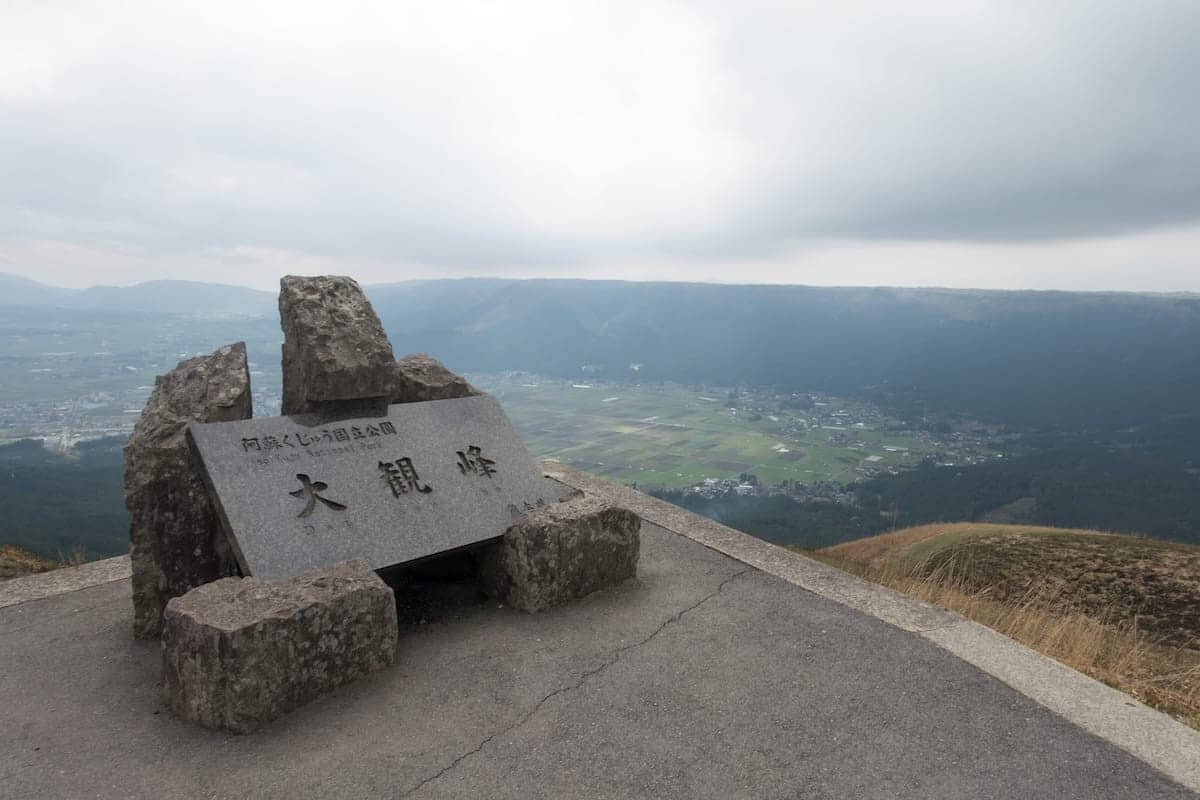
Daikanbo: The Top Lookout Over the Aso Valley and the Reclining Buddha
Daikanbo is the most famous lookout on Aso’s northern outer rim, at an elevation of about 936 meters. From up there you can take in the whole Aso Valley, the towns and farmland scattered through it, and the Five Peaks of Aso opposite, all in one view. From this angle the ridgeline of the Five Peaks forms the famous “Nehan-zo” (reclining Buddha), like a Buddha lying on his back.
The parking lot is free, and it is about a 5-minute walk from the lot to the lookout, with shops and restrooms along the way. This place is completely unaffected by the crater restrictions and is the top choice when the crater is closed. In the early morning, if conditions cooperate, you may even catch a sea of clouds welling up from the valley floor, with a higher chance on autumn and winter mornings. The altitude is high and the wind is very strong, so bring a jacket even in summer, and watch for icy roads in winter.
Next to the lookout are stalls selling coffee and light snacks, so you can enjoy the view with a hot drink. It is also a popular spot for photographing sunrise and the sea of clouds. If you plan to go in the early morning, remember to check whether the road is icy or closed in winter.

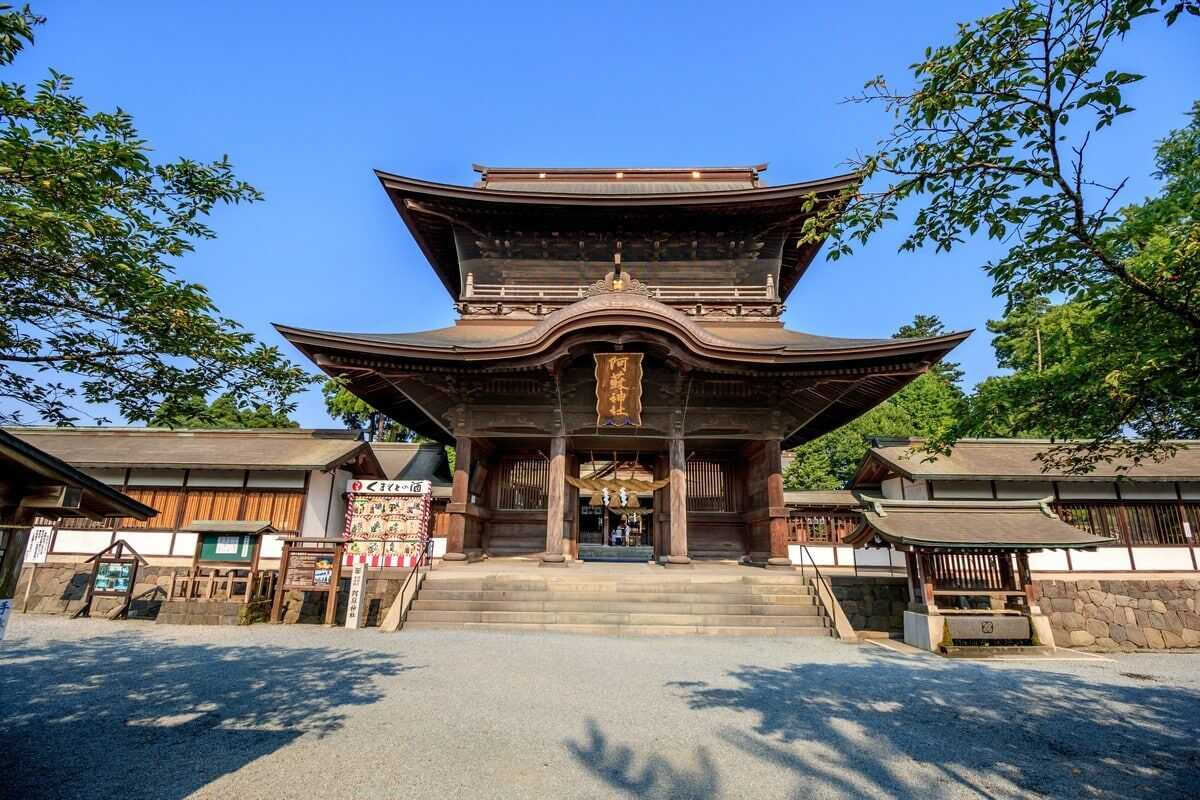
Aso Shrine: The Tower Gate Reborn in 2023, an Important Cultural Property
Aso Shrine is in Ichinomiya-machi, Aso City, and is the head shrine of about 500 Aso shrines across the country. The main deity is Takeiwatatsu-no-mikoto, and it is said to have been founded more than two thousand years ago, long serving as the spiritual center of the Aso region. Its most iconic feature is the rare two-story tower gate, counted among Japan’s three great tower gates.
In the 2016 Kumamoto earthquake, this tower gate, an Important Cultural Property, collapsed entirely and the worship hall was badly damaged. After 7 years and 8 months of restoration work, the tower gate held its completion ceremony on December 7, 2023, and along with the other 5 Important Cultural Property buildings and the worship hall and other main shrine buildings, all have been fully restored. You can now worship normally and walk through the tower gate. The shrine office offers amulets and goshuin stamps, and the grounds also have the “Takasago Pine” ritual of walking around it for good relationships.
Entry to the grounds is free, and it is about a 15-minute walk from JR Miyaji Station. We recommend spending 30 to 40 minutes. Please follow the etiquette of two bows, two claps and one bow when worshipping. The shrine’s restoration work was fully completed in December 2024, but please follow on-site directions when walking around.
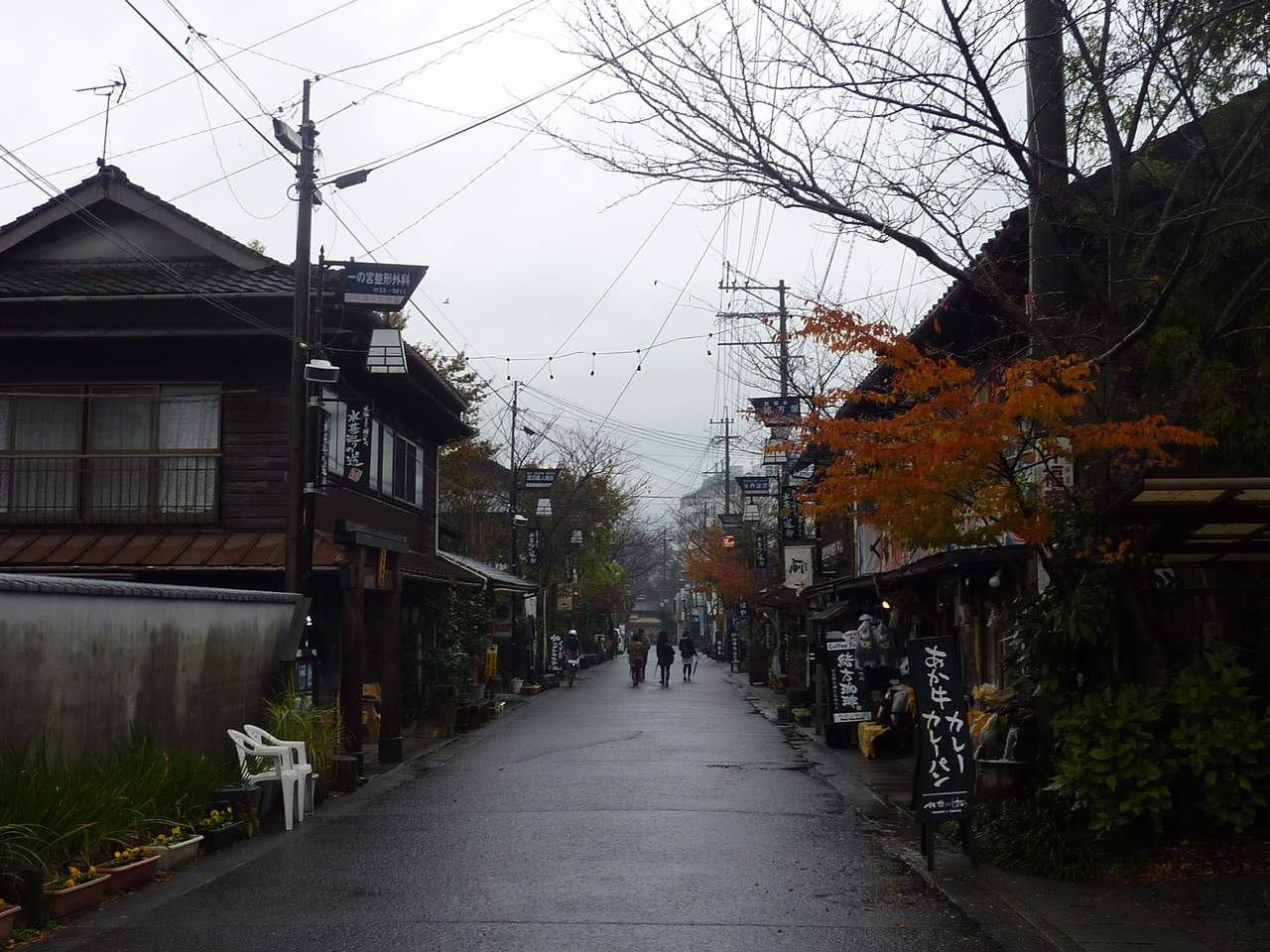
Monzenmachi Shopping Street: Sipping Your Way Along the “Mizuki Water Tour”
The Monzenmachi shopping street directly in front of Aso Shrine is not long, but it is the most lived-in stretch of road in Aso. Scattered along both sides are more than a dozen spring-fed water basins called “mizuki,” each with its own name and design, and the water is free to take. This route is known as the “Mizuki Water Tour.”
Aso’s groundwater is filtered through volcanic rock layers and tastes crisp and sweet, so remember to bring a water bottle to fill up. Along the street are tofu shops, Japanese confectionery stores, cafes and small restaurants using Aso ingredients, making it a good place to rest after visiting the shrine. Most shops close in the early evening, so we recommend scheduling this stretch for the afternoon. It is about a 15-minute walk from JR Miyaji Station, along the same route as Aso Shrine.
When taking water, please don’t touch the mouth of your bottle directly to the basin, and avoid washing things in the basins. These springs are a daily water source for local residents, so keeping them clean is basic courtesy.
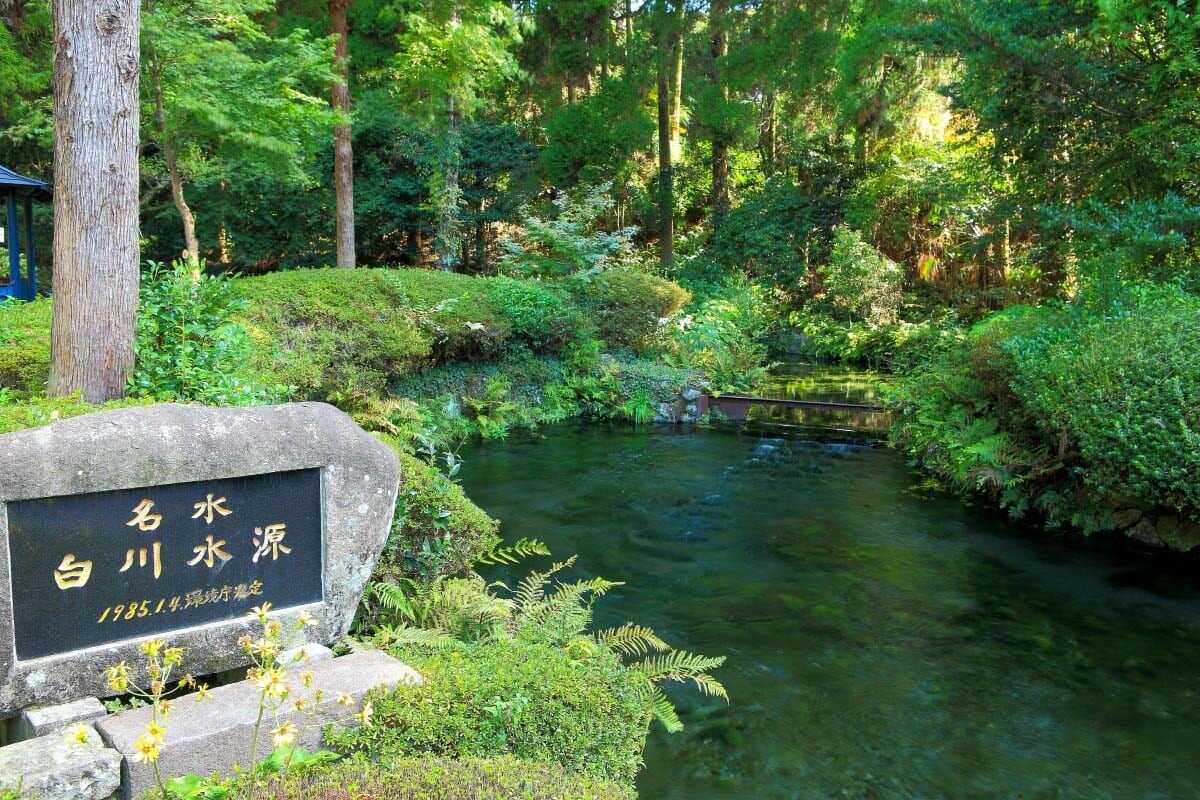
Shirakawa Suigen Spring: A 60-Ton-Per-Minute Spring Among Japan’s Top 100 Waters
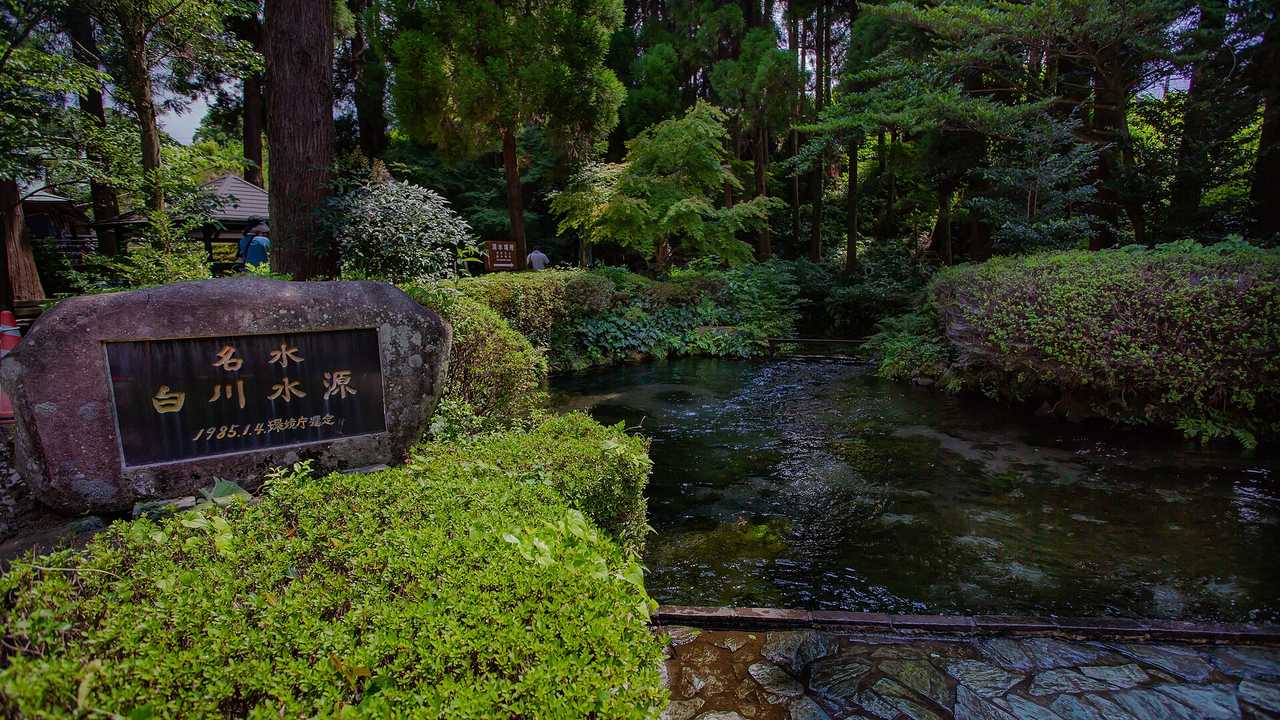
Shirakawa Suigen is in Minami-Aso Village. It is one of the Ministry of the Environment’s “Top 100 Waters of Japan” and the source of the Shirakawa River. The flow is astonishing, with about 60 tons of clear water per minute welling up from the sandy bottom. The pond is so transparent that you can see the fine sand being pushed and rolled by the water, and even in summer you feel cool standing beside it.
Entry requires an environmental conservation donation of ¥100 (high school age and up; free for junior high school students and under). Opening hours change with the season, so please check with Minami-Aso Village before you go. You can drink the spring water on the spot, and the local products hall also sells empty bottles. The parking lot beside the products hall has about 50 spaces and is free. The address is 2092-1 Shirakawa, Minami-Aso Village. It is in the Minami-Aso area, some distance from central Aso City, so keep the drive time in mind when planning.
The grounds have a boardwalk that circles the spring pond, entirely flat and walkable in about 15 to 20 minutes, and nearby is Shirakawa Yoshimi Shrine, which you can visit on the way.
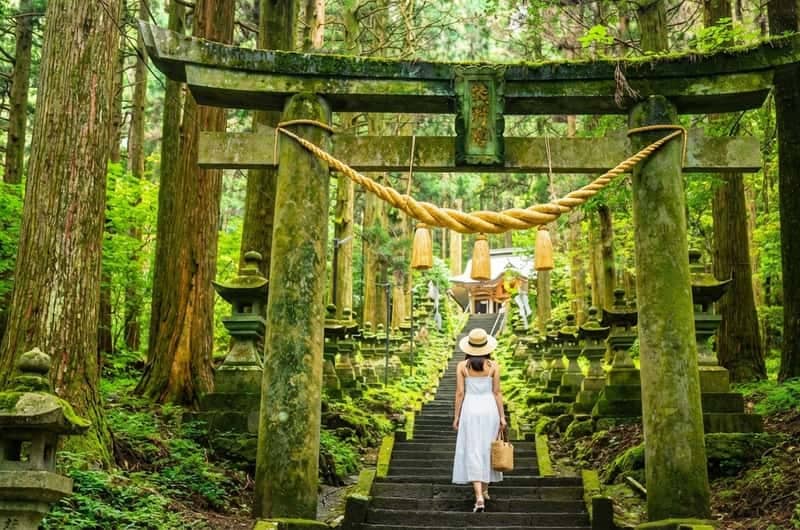
Kamishikimi Kumanoimasu Shrine: An Otherworldly Approach Lined With 97 Stone Lanterns
Kamishikimi Kumanoimasu Shrine is deep in a cedar forest in Takamori Town and is a hidden gem that has gone viral in recent years. Starting from the torii gate, 97 moss-covered stone lanterns stand on both sides of the long stone-stepped approach. Light filters down through the towering cedars, and when mist rolls in it truly feels like stepping into another world. Its reputation as a filming location for an anime has made it even better known.
Visiting is free and there is no admission fee. It takes about 10 minutes to walk from the entrance to the main hall. The stone steps are slippery and fairly steep, so wear non-slip shoes. Behind the main hall is a giant natural hole through the rock called “Nukido Iwa,” said to have been kicked through by an attendant of Takeiwatatsu-no-mikoto in a single kick and regarded as a symbol of breaking through difficulties. The grounds are quiet and solemn, so please keep your voice down and do not use drones.
There is no parking attendant on the grounds and spaces are limited, so park in the designated area and give way to local residents. The atmosphere is best in the early morning and when mist forms after rain, but that is also when the stone steps are slipperiest, so slow down.
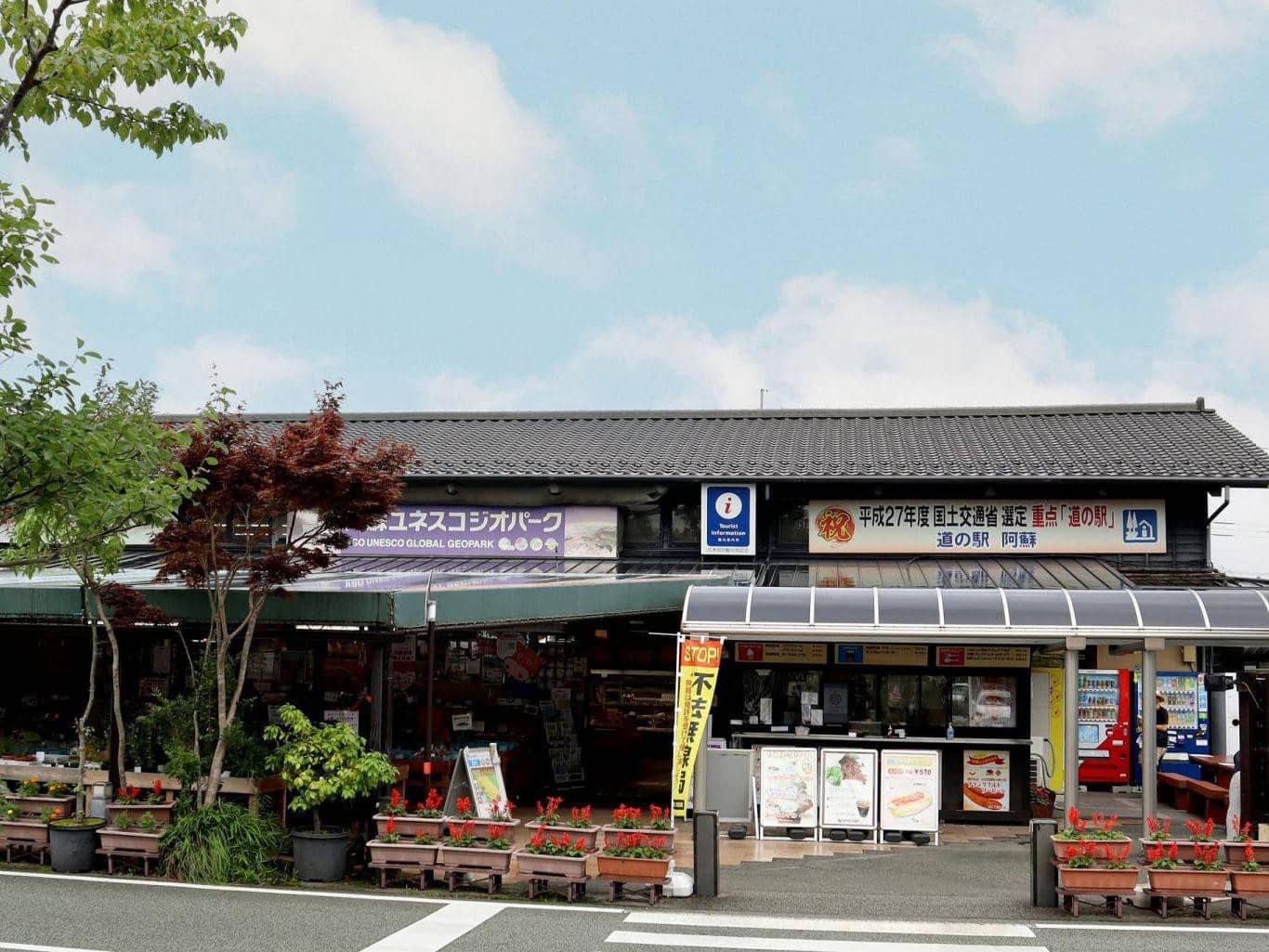
Michi-no-Eki Aso: A Supply and Tourist Information Stop Beside Aso Station
Michi-no-Eki Aso is right next to JR Aso Station, just a few steps from the station exit. It is the best place to kill time while waiting for a ride, and it doubles as a tourist information office where you can pick up the latest crater restriction and bus timetable information.
It sells agricultural products from the Aso plateau, Aso milk and pudding, processed akaushi beef products and a wide range of souvenirs, at more reasonable prices than in tourist areas. It also has a light-meal area and restrooms, plus free Wi-Fi. Because buses up the mountain are infrequent, the wait for the return ride is often long, and fitting your souvenir shopping in here is the most efficient use of time.
It also offers tourist consultation and services related to luggage storage, so if you are heading up the mountain that day and don’t want to haul your bags, you can sort that out here first. Opening hours change with the season, so we recommend confirming before you go.
Minami-Aso Railway: The Highland Train Fully Back in Service in 2023
The Minami-Aso Railway is a local railway running along the south side of the caldera. After the 2016 earthquake it was partly out of service for a long time, but it returned to full service in July 2023, reconnecting Tateno and Takamori and making itineraries around Minami-Aso workable again.
Along the line it passes scenic points such as the Shirakawa No. 1 Bridge, and it stops at the famously long-named station “Minami-Aso Mizu no Umareru Sato Hakusui Kogen.” Combined with the sightseeing train services, you can enjoy the highland countryside at a leisurely pace, another way to see Minami-Aso besides driving. Trains are not frequent, so if you want to connect to the Shirakawa spring or the Takamori area, check the timetable before planning your day.
Most stations along the line are unstaffed, so check how to buy tickets and pay in advance. If you use the sightseeing train, you usually need to reserve a seat beforehand, and in peak season it is often full.
Before You Go: Check the Day’s Crater Restrictions on the Official Website
This is the most critical but most often skipped step of the whole Aso trip. Volcanic activity levels can go up or down within a few days, and any “you can see the crater” on a guide, blog or travel agency page only reflects the moment it was written. The only reliable source is the restriction information published live by the officials.
The most authoritative source is the “Aso Volcano Crater Restriction Information” website (aso-volcano.jp) run by the Aso Volcano Disaster Prevention Council, which shows whether the crater is currently open, the restricted area and the update time, and can be checked on a phone. You can also cross-check the crater restriction page on the Aso City website and the Aso volcano activity status published by the Japan Meteorological Agency (JMA). We recommend checking again on the morning of departure, not just the night before.
It is also a good idea to save the contact details of your accommodation or car rental company, since when restrictions change suddenly they are usually the first to know about road and shuttle conditions on site.
Can You Visit Mount Aso Now? Restrictions and Opening Hours at a Glance
Many people search “Is Mount Aso open?” or “Mount Aso current status” before leaving, and the question really splits in two. First, can you go to the Aso area at all? The answer is almost always yes, because Kusasenri, the Aso Volcano Museum, Daikanbo and Aso Shrine are all outside the crater restriction zone. Second, can you approach the Nakadake crater itself? This is the part that opens and closes with the Eruption Alert Level.
As an example, here is the official information checked on October 4, 2026:
- Aso Volcano Disaster Prevention Council: The Eruption Alert Level was lowered to Level 2 (crater-vicinity restriction) at 4 p.m. on September 1, and from 9 a.m. on September 2 it is a “Stage 1 restriction,” with entry banned within about 1 km of the crater.
- Aso City website: The Aso-san Park Road is closed and crater viewing is currently not possible.
- Sankō Bus “Aso-san Crater Shuttle (阿蘇山火口シャトル)”: Service suspended (updated September 2).
In other words, there is no problem at all going to Aso now, you just can’t see the crater yet.
Once the crater reopens, the toll road to it, the “Aso-san Park Road,” has fixed operating hours. The entry gate closes 30 minutes before closing time, and entry is completely prohibited while the gate is closed at night:
- March 20 to October 31: 8:30 to 18:00 (entry gate closes 17:30)
- November 1 to November 30: 8:30 to 17:30 (entry gate closes 17:00)
- December 1 to March 19: 9:00 to 17:00 (entry gate closes 16:30)
- Crater viewing itself is free; if driving the park road, the toll for a standard car is ¥1,000
- If you aren’t driving, you can take the crater shuttle bus from the mountaintop plaza. In normal operation it is ¥800 one way for adults (junior high school age and up) and ¥400 for elementary school students and under
The officials note that these times may change at short notice depending on volcanic gas concentration and weather, and even during opening periods, crater viewing is suspended on site if the volcanic gas concentration at the crater rises. The recommended order for checking is: first look at the Eruption Alert Level and restricted area on the home page of “Aso Volcano Crater Restriction Information” (aso-volcano.jp), then check the “Crater viewing / toll road” page on the Aso City website to confirm whether the park road is open, and finally, if you use public transport, check the Sankō Bus “Aso-san Crater Shuttle (阿蘇山火口シャトル)” page to confirm whether the shuttle is running. Only when all three show open can you really walk to the crater’s edge that day.
How Much Does a Trip to Mount Aso Cost? Admission, Bus Passes and Guided Tours
Most of Aso’s natural scenery is free, and the main costs are transport tickets and museum admission.
Aso Volcano Museum Admission: ¥1,300 to See the Crater You Can’t Enter
This is the most worthwhile ticket to buy while the crater is closed. Admission is ¥1,300 for adults (junior high school age and up), ¥650 for elementary school students, ¥1,100 for ages 65 and over, and ¥350 for preschool children aged 4 and up, with discounted rates for groups of 11 or more. It is open 9:00 to 17:00 with last entry at 16:30, right across from the Kusasenri parking lot, just a few steps from the bus stop.
The ticket includes the five-screen theater, the giant three-dimensional terrain model and, most importantly, the live crater camera feed. This is the only way to see steam inside the Nakadake crater during restrictions. The museum is an indoor facility, so it is also the best refuge on the mountain when fog, strong wind or rain sets in.
We recommend spending 40 minutes to an hour, which pairs nicely with a stroll around Kusasenri to make a morning itinerary.
Tickets can be bought at the counter on the spot with no reservation needed. If you also want to try horse riding at Kusasenri, we suggest going into the museum first and coming out to photograph the grassland once the sun’s angle has softened.
The museum also posts the day’s crater restriction status and bus operating section inside, making it the most reliable information point on the mountain. After arriving, it is worth taking a quick look before deciding how to spend the afternoon.
The museum is right beside the bus stop, so it fits into your plans even if you only spend a morning at Kusasenri.
![Kumamoto Prefecture - [Popular Pick] Kyushu Kumamoto and Aso One-Day Trip | Kumamoto Castle Tour, Aso Volcano Sights, Kusasenri Walk, Volcano Museum Photo Stop, Aso Roadside Station | Boarding in Fukuoka or Kumamoto](https://res.klook.com/images/w_300,h_300,c_fill,q_75/w_80,x_15,y_15,g_south_west,l_Klook_water_br_trans_yhcmh3/activities/r8yeleq64nwfjetheett/【人氣必選】九州熊本阿蘇一日行|熊本城巡禮・阿蘇火山奇觀・草千里漫步・火山博物館打卡・阿蘇道路驛站|福岡或熊本上車-Klook.jpg)
- 🕘 Opening hours: 9:00 to 17:00 (last entry 16:30; a visit takes about 40 to 50 minutes)
- 🎫 Admission: Adults (junior high school age and up) ¥1,300 / Elementary school students ¥650 / Ages 65 and over ¥1,100 / Preschool children aged 4 and up ¥350
- 📅 Maintenance closures: January 14 and July 14 each year
- 🔗 Aso Volcano Museum official website (admission information)
Aso Tozan Line One-Day Pass: ¥2,000 for Unlimited Rides Up and Down the Mountain
Sankō Bus’s “Aso Tozan Line 1-Day Pass” has an official price of ¥2,000. It covers the section from Aso Station front to Kusasenri to Aso-san Jo Terminal, with unlimited boarding and alighting that day. Since one-way fares up the mountain are not cheap, it usually pays off as long as you ride up and down once each and also get off along the way.
Two things to note. First, Sankō Bus revised its fares on October 1, 2024, so the old one-way fares circulating online mostly no longer apply, and the actual amount should be confirmed at the bus stop and on the official fare table. Second, under the current crater restrictions the bus runs only as far as Kusasenri, so check the day’s operating section before buying a ticket.
The pass can be bought at the ticket office in front of Aso Station or on the bus. Remember to take a numbered ticket when boarding and just show the pass when you get off.
If you’re just going up the mountain for the day and heading back down after seeing Kusasenri, a one-way ticket may actually be better value, so check the day’s operating section and the fares before deciding.
The pass is valid for the day of issue only and cannot be used across days. If you plan to stay two nights in Aso and go up the mountain on two separate days, you need to buy one for each, in which case one-way tickets may actually be cheaper.
The ticket office can also confirm the day’s last bus time, so it is safest to ask when you buy your ticket.
Sightseeing Train “Aso Boy!” Reserved Seats: Turn Your Transport Into an Attraction
On the Hohi Main Line section from Kumamoto to Aso, you can choose the sightseeing limited express “Aso Boy! (あそぼーい!).” The cars are themed around “Kuro,” a black-and-white puppy, and have side-by-side family seating facing the windows, a children’s play area and a lookout seating area. Along the way you can also see the famous zigzag switchback section.
Reserved seats must be booked separately. They are often full in peak season and on weekends, so we recommend booking early on the JR Kyushu website or at a station’s green window (ticket office). If you hold a Kyushu Rail Pass, reserved seats can usually be booked and used with it, so one ticket turns your travel time into an experience.
Departures are few, only a handful a day. Please rely on the official JR Kyushu timetable for times, and remember to leave time for the transfer to the bus up the mountain.
The train has a sales counter and commemorative stamps, which are especially popular with families. If you can’t get a reserved seat, the Kyushu Odan Express on the same section also lets you enjoy the highland scenery along the way.
The operating section and stops change with the season, and in some periods the train runs only on weekends and holidays. When planning, be sure to rely on the latest operating calendar published by JR Kyushu rather than copying the schedules from older articles.
If you simply want to get there and don’t care about the themed cars, a regular train gets you there as well, at a lower fare.
![Kumamoto Prefecture - [Aso Boy Train Experience / Takachiho Boat Experience] Takachiho Gorge + Kusasenri + Mount Aso | Departing from Fukuoka](https://res.klook.com/images/w_300,h_300,c_fill,q_75/w_80,x_15,y_15,g_south_west,l_Klook_water_br_trans_yhcmh3/activities/lt7ulvfysolwmy4w2vrv/【阿蘇男孩列車體驗高千穗遊船體驗】高千穗峽谷+草千里+阿蘇山|福岡出發-Klook.jpg)
Shirakawa Suigen Environmental Conservation Donation: ¥100 for a Sip of One of Japan’s Top 100 Waters
Shirakawa Suigen is not admission in the usual sense but an environmental conservation donation of ¥100 (high school age and up; free for junior high school students and under), used to maintain the environment around the spring. Opening hours change with the season, so please check with Minami-Aso Village before you go.
You can drink the spring water directly on site, and the local products hall also sells empty bottles, which many travelers take home to make tea or cook rice. The parking lot has about 50 spaces and is free, right beside the products hall.
It is at 2092-1 Shirakawa, Minami-Aso Village, in the Minami-Aso area. If your itinerary centers on Kusasenri and Aso Shrine, you need to arrange a separate drive, so driving is smoother. If you use public transport, we suggest planning it together with the Minami-Aso Railway.
The donation is paid in cash at the entrance, so bring small change. The water-taking area is open year-round, and in summer the spring water stays at about 14 degrees, making it a great place to cool off.
The products hall near the spring sells Minami-Aso farm produce, tofu and sweets, with products made using the spring water being a specialty here, so it is convenient to shop on the way.
The grounds are not large, and it works best to schedule it on the same day as Kamishikimi Kumanoimasu Shrine and the Takamori area.
Horse Riding at Kusasenri: Being Led Around a Volcanic Grassland
Horse riding at Kusasenri is a classic Aso activity. Ranch staff lead the horse around the grassland, with several options depending on route length. The short ride takes about 5 to 10 minutes, and the longer one can circle to the pond for photos. You can sign up on the spot with no reservation needed.
Because the horse is led, even people with no riding experience, and children, can take part. The highlight is the grassland in the background and the steaming Nakadake in the distance, which makes for very recognizable photos. Operations are affected by the weather, and the ride may be suspended in rain, strong wind or muddy ground.
Fees and routes are as announced on site, and we suggest bringing a little cash. This activity is outside the crater restriction zone and goes ahead as usual while the crater is closed.
There is also a led pony experience on site, suitable for younger children. Note that animals can be startled, so please don’t walk behind the horses or make sudden loud noises.
Staff lead the horse and help with photos throughout, so you don’t need to bring any equipment, just wear shoes that are easy to walk in, and skirts are best avoided.
After the ride, you can walk further into Kusasenri, where the view looking back at Nakadake from the pond’s edge is the widest.
Aso Day Trips From Kumamoto/Hakata: Skip the Long Waits for Infrequent Buses
Buses up the mountain run only about 9 times a day, and making the connections is the biggest pain point for independent travelers. If your time is limited, a Chinese-language chartered car or group bus day tour from Kumamoto or Hakata is much easier. It usually links highlights such as Daikanbo, Kusasenri and Aso Shrine, for about 8 to 10 hours in all.
These tours mostly include transport and a guide but not admission tickets or meals, so before signing up check whether the Aso Volcano Museum admission is included. More importantly, whether you can enter the crater depends on the day’s restrictions, so before booking be sure to confirm the operator’s policy on itinerary changes and refunds when restrictions affect the tour.
Drivers don’t need to join a tour, since renting a car and combining it with the Aso Panorama Line gives you more freedom.
Before signing up, we also suggest confirming the meeting point and drop-off time. Some tours end in central Kumamoto rather than Hakata, and you would then need to take the Shinkansen back yourself.
If the tour includes Daikanbo, remember to bring a jacket. The lookout is high and windy, and even if it feels hot in the vehicle in summer, you will clearly feel the cold once you get out.
Confirming the volcano restrictions and itinerary changes with the operator once more the day before departure will save you a lot of hassle on site.
Tours usually include insurance, but we still suggest checking the coverage and the conditions that apply to mountain activities yourself.
Where to Stay Near Mount Aso: Recommended Areas for Combining Sightseeing
Near Aso Station, Uchinomaki Onsen or Minami-Aso? How to Choose Among the Three Areas
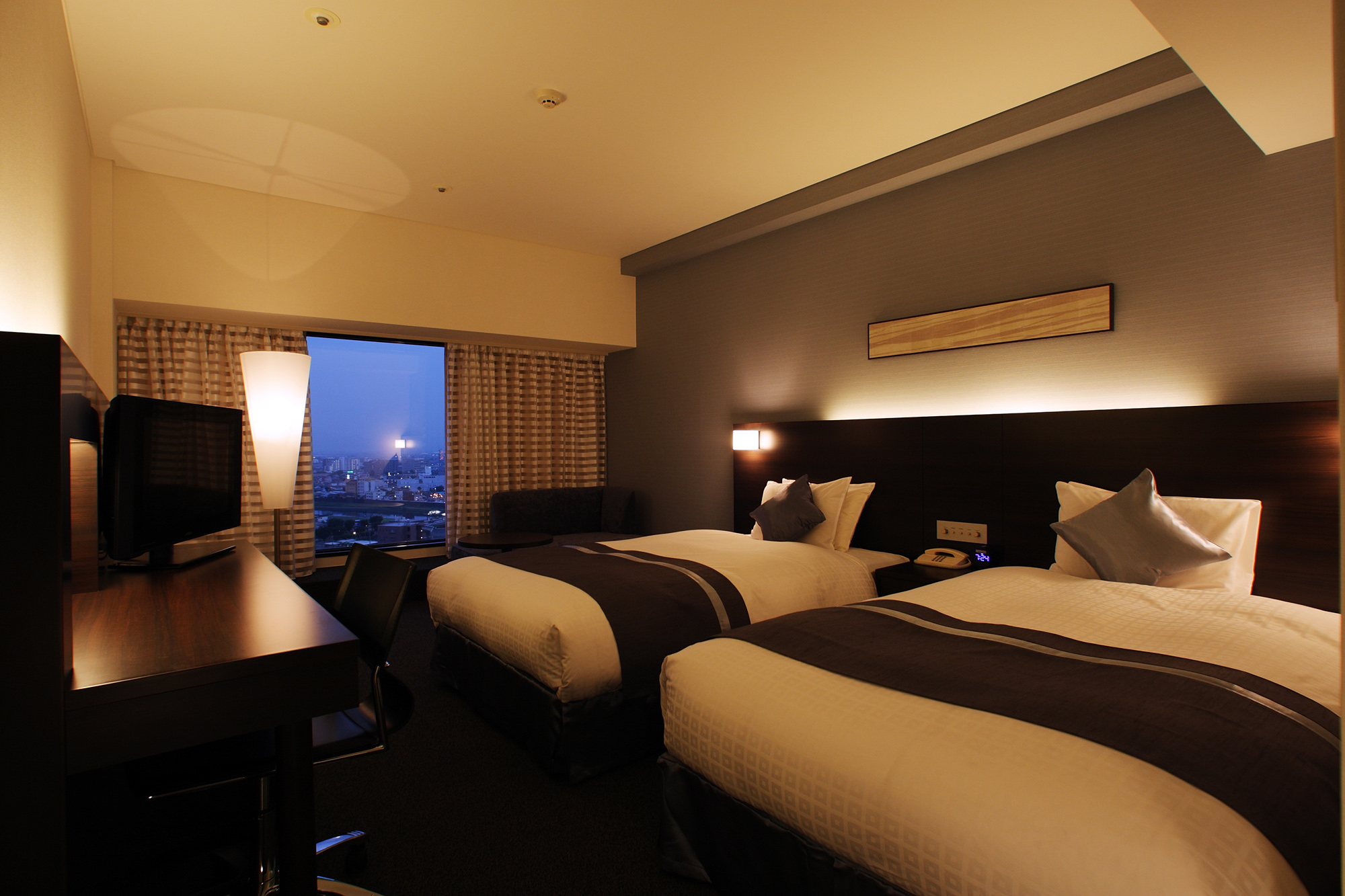
Aso’s attractions are spread out, and where you stay directly affects how efficient the next day’s itinerary is. If you want to catch the first bus up to Kusasenri in the morning, staying around JR Aso Station and Michi-no-Eki Aso is the most convenient, and restaurants and convenience stores are concentrated there too.
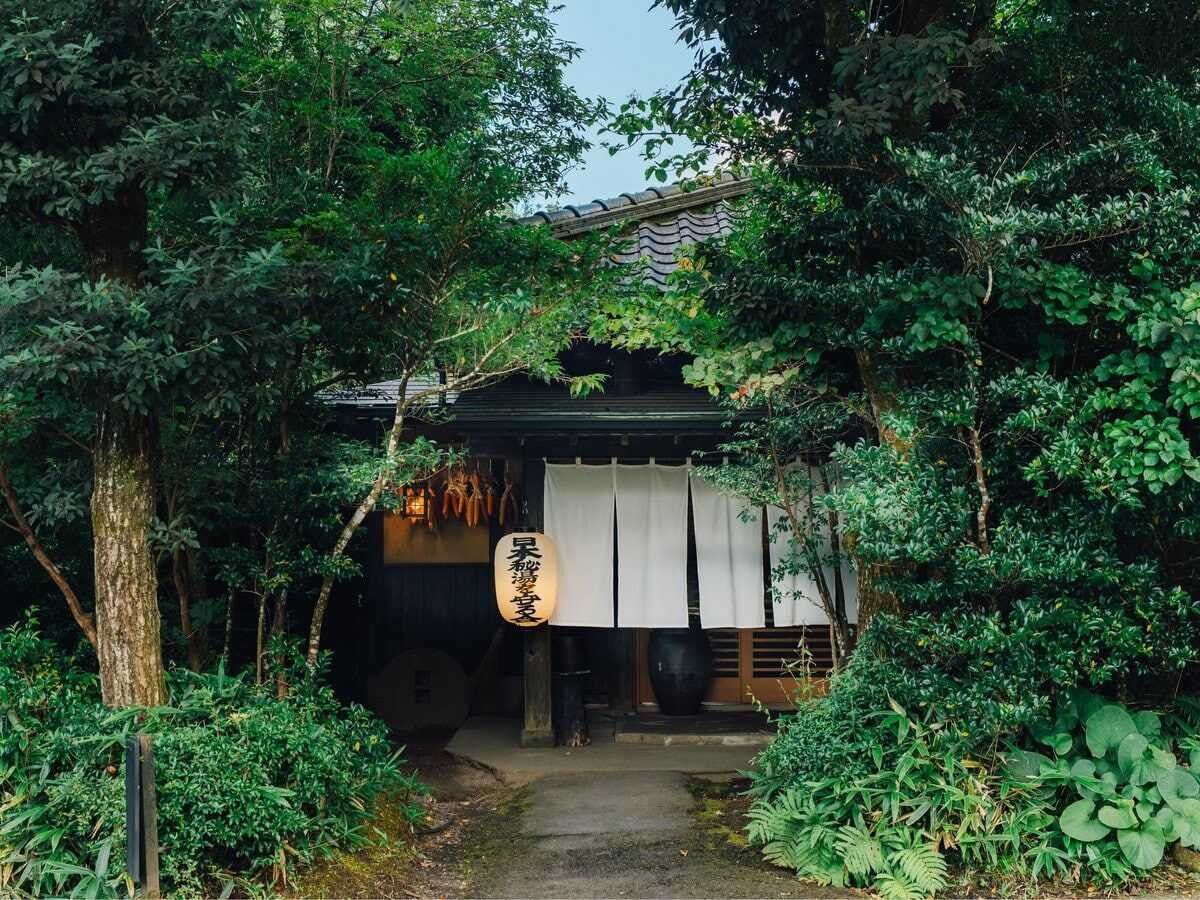
If you want to relax in a hot spring, choose Uchinomaki Onsen on the north side of the caldera, Aso’s largest hot spring town, with many inns and mild waters, about a 30-minute drive to Kusasenri. If your itinerary centers on the Shirakawa spring, Kamishikimi Kumanoimasu Shrine and the Minami-Aso Railway line, staying in Minami-Aso Village or the Takamori area will be smoother, with plenty of guesthouses and villa-style lodging, which suits drivers.
Aso has relatively few rooms overall, so book early for the peak scenery seasons and holiday weekends. Many mountain lodgings have no public transport access, so confirm how to get there before booking.
Mount Aso FAQ
Q: Can you enter the Aso Nakadake crater now?
It depends on the day’s restrictions. You can visit Aso, but you can’t currently approach the Nakadake crater. Mount Aso was lowered back to Eruption Alert Level 2 on September 1, 2026, and a Stage 1 restriction has been in effect since September 2, banning entry within about 1 km of the crater. Crater viewing has still not reopened (the official website still showed a Stage 1 restriction on October 4). Levels go up and down, so check the latest official announcements before you leave.
Q: How do I check the latest Aso crater restrictions?
Rely on the Aso Volcano Disaster Prevention Council’s “Aso Volcano Crater Restriction Information” website (aso-volcano.jp), and cross-check the Aso City website and the Japan Meteorological Agency’s Aso volcano activity status. We recommend checking again on the morning of departure.
Q: Is the Aso ropeway still there? Can I take a ropeway up to the crater?
No, it is gone. The Aso ropeway was damaged by the earthquake and volcanic activity, the rebuilding plan was cancelled, and the facility has been demolished. The current option is the crater shuttle bus that began service in 2020, which costs ¥800 one way for adults in normal operation, but it is currently suspended because of the restrictions.
Q: How do I get from Kumamoto to Aso? How long does it take?
The Hohi Main Line limited express from JR Kumamoto Station to Aso Station takes about 1 hour 15 minutes to 1.5 hours, or you can take the Kyushu Odan Bus from the Sakuramachi Bus Terminal. After arriving at Aso Station, transfer to the Sankō Bus Aso Crater Line up the mountain, about 30 minutes to Kusasenri.
Q: How much is admission to the Aso Volcano Museum?
Admission is ¥1,300 for adults (junior high school age and up), ¥650 for elementary school students, ¥1,100 for ages 65 and over, and ¥350 for preschool children aged 4 and up, with discounts for groups of 11 or more. It is open 9:00 to 17:00 with last entry at 16:30, right across from the Kusasenri parking lot.
Q: Is Aso still worth visiting if the crater is closed?
Absolutely. Kusasenri, Daikanbo, Komezuka, Aso Shrine, Shirakawa Suigen and Kamishikimi Kumanoimasu Shrine are all outside the restricted area and open as usual. The Aso Volcano Museum also lets you see the steam inside the crater through its live cameras.
Q: Can I approach the Aso crater if I have asthma or a heart condition?
It is not recommended. The area around the crater releases volcanic gases such as sulfur dioxide. Even during opening periods, people with asthma, bronchial conditions or heart conditions are still advised against entering the crater area, and warning signs and evacuation shelters are posted on site.
Q: How long should I stay in Aso? What season is best?
If driving, you can cover Kusasenri, Komezuka, Daikanbo and Aso Shrine in one day; if taking the bus, we recommend a relaxed itinerary or staying a night. Any season works, with golden pampas grass in autumn and possible road closures in winter. The altitude is high and windy, so bring a jacket all year round.